
The Legacy of the Jahanian Brothers
The Legacy of the Jahanian Brothers
A Zoroastrian Mercantile Household from Yazd
Personal, Family, Commercial, and Political Correspondence of the Jahanian
Household during the Qajar Period
(1879–1916)
Research and Analysis by:
Mahdi Vaziniafzal and Jamshid Varza
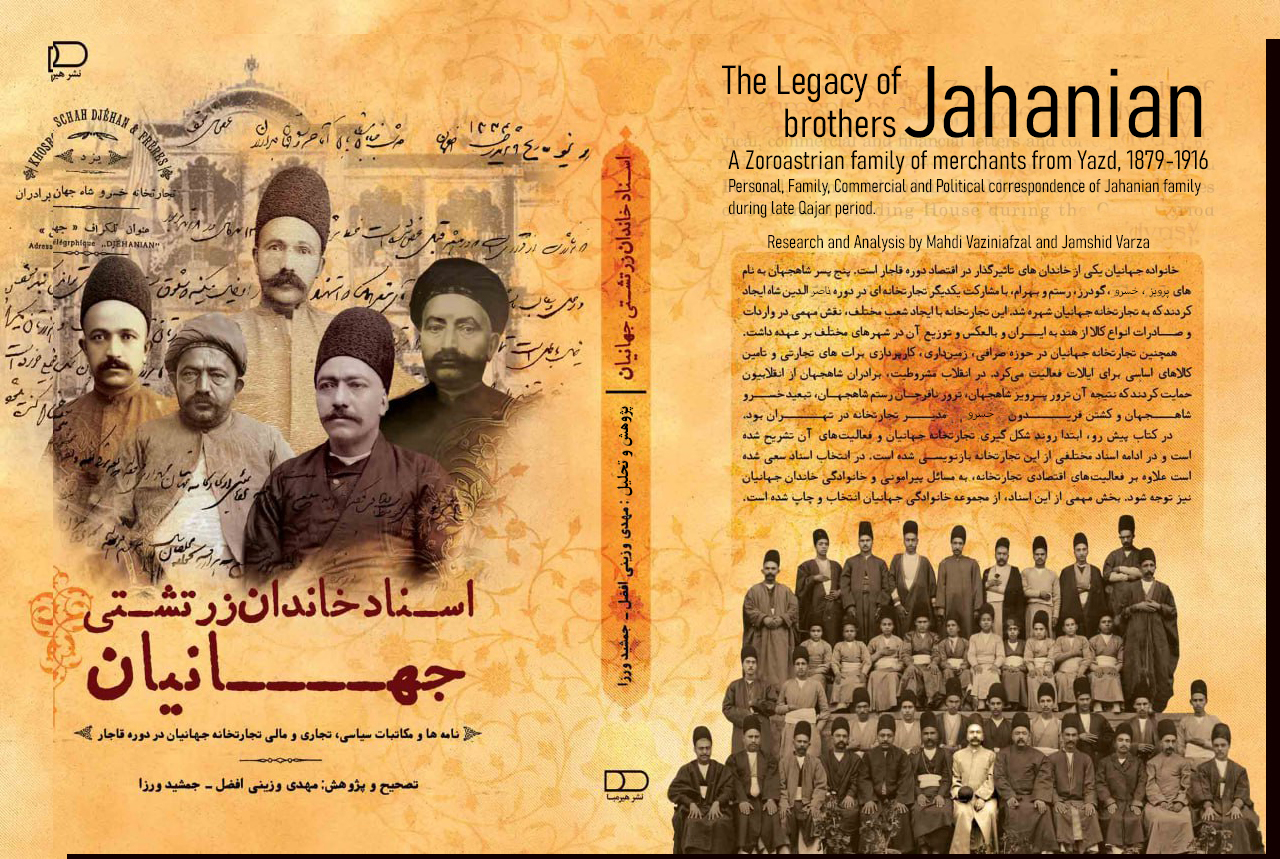
This book examines the social, religious, and economic life of one of themost influential Zoroastrian households in nineteenth-century Iran. The Zoroastrian Jahanian household was among those who successfully took
advantage of new economic conditions in Iran and, through close ties with the Parsis of India, became one of the most prominent Zoroastrian households in the country. Their commitment to freedom, independence,
opposition to despotism, and support for the Iranian Constitutional Revolution of 1906 brought them under severe pressure from the Qajar state.
The killing and exile of members of this household by the Qajar government turned their story into a national tragedy in modern Iranian history. Life for Zoroastrians in nineteenth-century Iran, who were concentrated
mainly in the provinces of Yazd and Kerman, was extremely difficult. The Muslim majority did not recognize them as having equal rights and imposed on them a heavy religious poll tax known as jizya.
Under such circumstances, Shahjahan and Firoozeh, a Zoroastrian couple of modest financial means, lived in the city of Yazd. They raised five sons who, by the late nineteenth century, established one of the largest commercial enterprises in Iran. The two eldest sons, Parviz and Khosro, began their activities by founding an
import–export business with India. They exported Iranian agricultural products and imported goods required by the Yazd market. As their commercial activities expanded, they also began to provide financial and
money-transfer services in order to facilitate trade for their clients and business partners.
Gradually, the activities of the Jahanian brothers led to the establishment of “The Trading Company of Khosro Shahjahan and Brothers,” operating under the commercial name Jahanian, with branches in several Iranian cities. This company became the first Zoroastrian enterprise to extend its operations across the entire country. In addition to its domestic branches, the Jahanian Company also established offices in Bombay and London. The expansion of its money-changing and financial operations made it one of the pioneers of banking services in Iran. At certain points, the company was responsible for paying the salaries of soldiers and gendarmes and for transferring taxes collected by government agents to the treasury in Tehran. The company also
played a major role in supplying provisions to Tehran, exporting cotton, opium, and carpets, and importing various textiles from India and England.
During the decades of economic success and expansion of the Jahanian enterprise, Iran experienced the Constitutional Movement, which led to the establishment of a constitutional monarchy, proclaimed by Muzaffar al-Din Shah. The Jahanian brothers clearly recognized the importance of this transformation and supported the newly established parliament. The next Qajar ruler, Mohammad Ali Shah, adopted a hostile stance toward
constitutionalism. He ordered the bombardment of the parliament building, and many supporters of the parliament were assassinated or forced into exile.
Using their commercial network, the Jahanian household supplied arms and ammunition to constitutionalists in Tehran and Tabriz. These actions provoked the anger of the central government and resulted in the
assassination of Parviz, the eldest son, in front of his home in Yazd. Rostam, the fourth brother, survived an assassination attempt in Shiraz. One year later, Fereydoun Khosro, head of the Tehran branch, was brutally murdered in his home at night. Khosro, the second brother, was forced into exile by royal order. After reaching Bombay, he traveled to London, where he met Dadabhai, a Parsi and a representative of India in the British Parliament, and asked for his assistance in deposing the Shah and securing the return of Iranian exiles.
Despite these events, the Jahanian Company continued its operations and later acquired the concession for telephone services in Iran. The company remained active until 1916. The five Jahanian brothers played an active role in Zoroastrian communal life and became members of the Nasseri Zoroastrian Anjuman of Yazd. They were deeply engaged in philanthropic activities, including the construction of guesthouses, schools such as the Khosravi School, fire temples, public baths designated for Zoroastrians, the promotion of education for Zoroastrian girls, and the printing and publication of Zoroastrian books.
The authors of this book, Mahdi Vaziniafzal and Jamshid Varza, have drawn upon family documents, commercial correspondence, and a large collection of photographs, many of which have never been published before. These materials were gathered from the National Archives of Iran, Varza’s private archive, and family collections of Iranian Zoroastrians. Most of the photographs come from Varza’s collection as well as those of other members of the household.
These documents are published here for the first time and present a new perspective on the lives and social activities of Zoroastrian households in Iran.
This book has been published in Iran by Hiromba Publications in 820 pages
The book is available for purchase online via Amazon at the following link:
Mahdi Vazini Afzal, Ph.D. History
Assistant Professor Department of History and Archeology
Assistant Professor Department of History and Archeology
University of Jiroft, Iran
Researcher, Goethe University Frankfurt
Mobile: +4915739432231