
The Women Excluded from Parsi Life
The Zoroastrians of India are a tiny and rapidly shrinking group. Yet they exclude women who marry out and their offspring from their community.
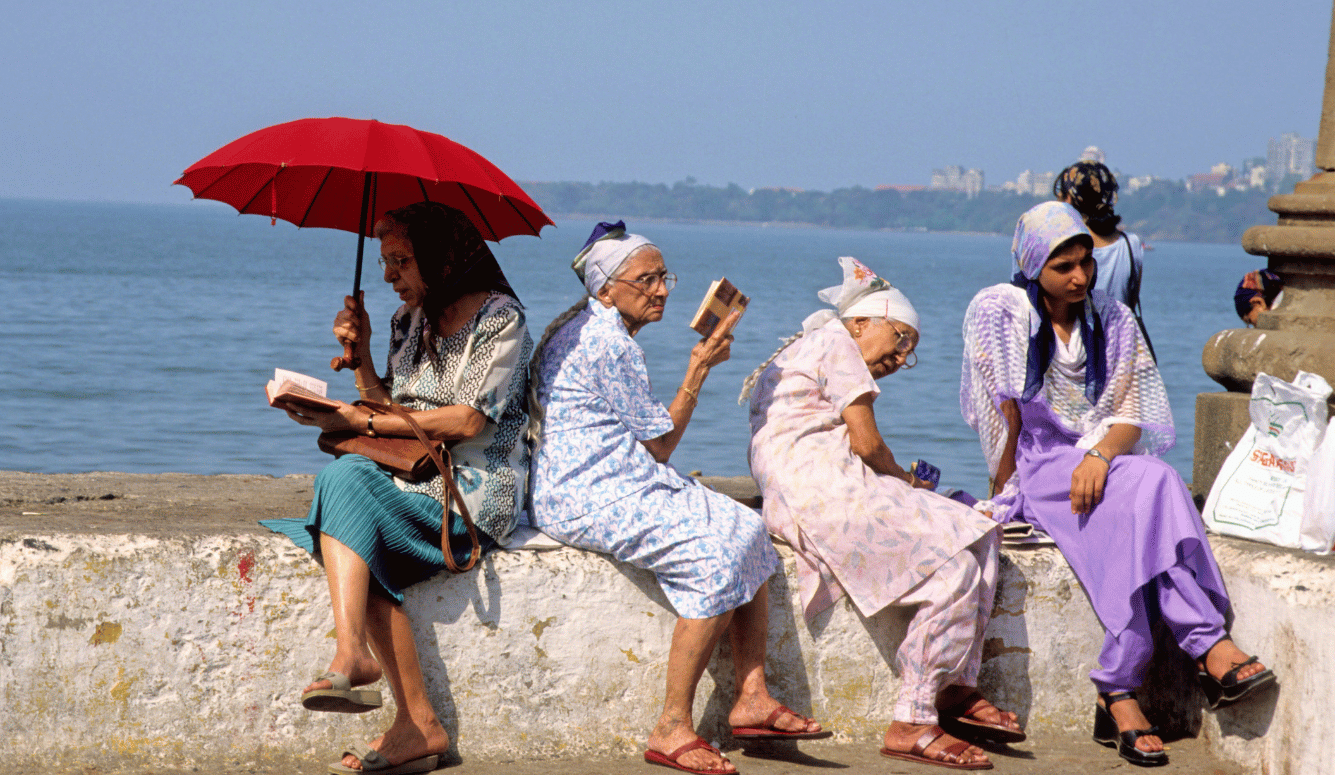
Although we may see ourselves as especially progressive, I have since realised that it’s only part of who we are. Despite our shrinking numbers, women are discouraged from marrying outside the community and face significant discrimination when they do. Since roughly half of all Parsi (men and) women have married non-Parsis, this means that a quarter of our population in India—and their children—are no longer officially counted as Parsis. In 2009, two intermarried Parsi women even found themselves cut off from the right to attend their own parents’ funerals. Since the Indian Constitution guarantees freedom of religion, these women—Gulrokh Gupta and her sister Shiraz Patodia—petitioned the Supreme Court of India for this basic right. In 2017, the Court found in their favour, but the fight for marital equality between Parsi men and women has barely begun.
The Parsis are the descendants of Zoroastrians who migrated to India between 600 and 1100 AD, during and after the Arab conquest and Islamisation of Persia, travelling across Afghanistan or navigating the Straits of Hormuz in small groups. The local Hindu population referred to the Zoroastrian migrants as Parsis, i.e. people from Pars (Persia). The resilient refugees settled first in Gujarat and later in Bombay, Karachi, Lahore, Ahmedabad, and other cities. Over the centuries, they worked first as farmers and later as shopkeepers, traders, accountants, and bankers, forming a successful middleman minority that flourished during the British colonial occupation of India. Prior to 1874, there was no distinction between Parsis and Zoroastrians. In that year, an Englishman, Rev Archibald Henry Sayce (1845–1933) coined the word “Zoroastrianism” to describe the religion founded by the Prophet Zoroaster, whose adherents may have any ancestry. Today, the word “Parsi” denotes a race or ancestry, while “Zoroastrian” refers to a follower of the religion hailing from India, Iran, or elsewhere.The 1941 Indian census counted 114,890 Parsis, primarily living in Bombay. However, by 2011, the Parsis in India had dwindled to 57,264, a number that had shrunk to an estimated 37,000 by 2023. This decline is usually attributed to the community’s aging demographic profile, caused by the late or non-marriage of members and their low fertility rates, as well as by migration out of India. An estimated 60,000 Parsis live in the diaspora, especially in the English-speaking world, with around 25,000 in the US; 7,000 in Canada; 4,000 in the UK; 3,000 in Australia; and 1,500 in New Zealand. A further 10–15,000 live in the ancestral homeland of Iran. However, the most obvious cause of the precipitous decline in the Parsi population—the deliberate expulsion from the community of 25 percent of Parsis and their descendants—is generally ignored.
Intermarried Parsi women in India are excluded from many of the benefits of community membership. They cannot receive funds from Parsi charitable trusts for education or medical help, nor are they entitled to housing within one of the Bombay Parsi baugs. The baugs are enclaves, some of them gated, built by philanthropists in the 1800s to house the growing Parsi community. They contain bungalows, row houses, and apartments, arranged around gardens featuring community halls, fire temples, cricket pitches, and convenience stores, in quads reminiscent of those of an Oxford or Cambridge college: oases of calm amid the chaos of India’s second largest city.
Originally, they were assigned to low-income families, but these effectively rent-controlled properties have become highly desirable: a bonanza for the select few whose families have handed their tenancies down over the generations. Since these verdant colonies were built for Parsis, intermarried women cannot inherit the right to live there, nor can they live in them with their non-Parsi spouses.
These properties are managed by a community organisation known as the Bombay Parsi Panchayet (BPP). The word “panchayet” means group of five, which was historically how Indian villages were governed. The BPP was established by the British Governor Gerald Aungier in 1672 so that community affairs and disputes could be managed by local leaders. At the time, it had quasi-legislative and judicial powers. Over the following centuries, the governing committee of BPP grew to first twelve and then eighteen members. Presently, seven members are elected to serve seven-year terms by the roughly 25,000 Parsis living in Bombay. BPP is a charitable trust and is the city’s largest private landlord, with over 5,500 residences and properties. The trust owns a significant number of rent-controlled homes, as well as running a subsidised Parsi seniors’ home. As the custodian of community funds, the BPP determines which members of the community it will support and which it will not. It also represents the community politically in national and governmental matters, alongside the Zoroastrian representative on the Commission for Minorities. Funded by generations of donors through the centuries, the BPP provides a number of benefits, which are restricted to “Parsi Zoroastrians.”
How does one get that designation? Zoroastrian identity is established by a religious ceremony called the navjote, which is somewhat analogous to the Catholic First Communion, Protestant Confirmation, or Hindu Janev ceremony, in which Brahmin boys are invested with a sacred thread. The word “navjote” is a Latinised form of the Parsi Gujarati compound of nav (new) and jote (reciter [of prayer]). Jote is also the Gujarati word for light, spark, or flame. (In Iran, this ceremony is known as sudreh-pushi.)
A child typically has their navjote ceremony at age five, seven, or nine—it is generally performed before puberty. It is unclear when this tradition began. While ninth–twelfth-century Zoroastrian religious texts contain instructions for the ceremony, it is also described in an earlier text, the Vendidad, which is considered to have originated before the eighth century BCE. Wearing a shawl and white satin pyjamas, the navjotee is brought before assembled family and friends, and seated in front of the priest who wears the traditional white linen jamo (long tunic-like garment). The priest then recites prayers and benedictions, exhorting the initiate to follow the path of goodness, after which he invests the child with the religious garments: their first sudreh (a white muslin undershirt) and kusti (a twine woven of lambswool), which he winds around their waist. The child repeats the prayers, memorised over long hours of practice, announcing to the gathering that he or she accepts the religion of the Prophet Zarathustra. The women of the family then form a privacy barrier and dress the child in a new suit or dress. The child is garlanded and receives hugs and presents from rejoicing parents, family, and friends. The festivities are usually concluded with a feast. After the navjote ceremony, Zoroastrians are considered full members of the religious community and only then can they enter the Parsi agiaries (fire temples).
Though many diaspora Parsi communities are far more liberal, in India priests do not publicly perform the navjote ceremony for mixed-race children, especially if the father is the one who is not a Parsi. This means that children of mixed marriages often cannot enter fire temples. The gates of these structures bear prominent signs proclaiming, “No admittance to non-Parsis,” and the entrances are often guarded. Parsi women who have married out of the faith are also excluded from the fire temples—even to attend their own loved-ones’ funerary services.
For centuries, the Zoroastrians have practised sky burial: exposing corpses to the elements to be consumed by vultures on the top of structures known as Towers of Silence (they resemble giant upside-down colanders). The Towers are often located in secluded forested areas. The ones in Bombay are nestled within a verdant pocket of hillside, entrance to which is barred to non-Parsis. While only a few selected pall bearers accompany the bodies all the way to the Towers of Silence, the deceased’s family traditionally takes part in a two-day farewell retreat during which funerary prayers are recited in special halls (bunglis), giving families a chance to grieve together and comfort each other. Intermarried Parsi women are excluded from these gatherings.
When Gulrokh Gupta and her sister Shiraz Patodia each married a Hindu man, they were told that they would be barred from attending the last rites of their own parents. The sisters sued the Anjuman Parsi Trust of Valsad in the Indian state of Gujarat, which manages the local fire temple. In 2017, after an eight-year legal battle, they finally won the right to enter the fire temple to attend prayers for their parents at their deaths. However, this success did not result in their gaining other religious rights. They could attend their parents’ last rites but were otherwise barred from the fire temple and could not themselves be given a sky burial.
Orthodox Parsis oppose intermarriage because they want to preserve the Parsi bloodline or perhaps—given the considerable achievements of Parsis within Indian society—this is an attempt to bathe in the reflected glory of descent from illustrious ancestors. But while such an attitude may seem like a relic of a more illiberal time, as Prochy Mehta has pointed out, the taboo against intermarriage is actually relatively new. Until around 1830, Mehta contends, intermarriages were common and widely accepted—an argument that is backed up by DNA evidence of ethnic mixing among Indian Parsis, around a quarter of whose DNA is typically South Asian. The idea of Parsi racial purity, then, is a myth. But then why, after centuries of intermarrying with local populations, did this community turn inward and forbid intermarriage?
In the mid-nineteenth century, a number of Protestant and Anglican missionaries were active among India’s Zoroastrian communities. Farshid Namdaran has traced the history of fifteen male Parsi converts to Christianity over the period 1839–1900. The Parsi community, Namdaran reports, responded with general outrage to these men’s baptisms and the converts were ostracised. It is likely that community elders were horrified by the conversions—they were seen as betrayals, repudiations of the Parsi community. By the late 1800s, Parsi numbers were already diminishing so the loss of young men to another faith must have terrified the Parsi elders. Their response was to double down on Parsi identity. Accepting a non-Parsi spouse was now seen as diluting the community’s cultural heritage, its parsi-panu. It became taboo to leave the religion, whether through conversion or intermarriage, for both men and women.
There were also legal hurdles to intermarriage at the time. In India, each religious community was governed by a separate civil code, an arrangement dating back to the British Raj and still largely in place today. Hindu marriage, divorce, succession, adoption, and inheritance cases are adjudicated according to the Hindu Marriage and Divorce Act. Muslim personal and family disputes are litigated under the Muslim Marriage and Divorce Act. The Parsi Marriage and Divorce Act of 1865 stipulated that both the bride and groom had to be Parsi. Individuals of different faiths could wed under the 1872 Special Marriage Act—but only if they renounced their religions. Therefore, Parsi men and women who married outside the faith were considered lost to the community. As a result, each Parsi family tree contains a large number of unmarried aunts, uncles, great aunts, and great uncles, many of whom must have relinquished the chance of marital happiness in order to remain part of the community. This tragic situation improved somewhat after Indian Independence in 1947, since the amended Special Marriage Act of 1954 allows intermarried partners to retain their own religious identities.
But regardless of the injunction against inter-religious relationships, Parsis did have children with non-Parsi partners. In fact, on two significant occasions, the children of Parsi fathers and non-Parsi mothers (but not vice versa) were accepted into the fold en masse through group navjotes performed by respected priests, hence setting the precedent for a double standard that persists to this day.
On 26 June 1882, a group of priests that included the now-venerated Dastur (‘Reverend’) Jamshed Kukadaru performed the navjotes of nine poor male and female dockworkers from Mazagaon (now part of Bombay), ranging in age from 35–77, as well as of two children. All of these people were the offspring of Parsi men and Hindu women. It is likely that the mothers of these dockworkers were also the common-law spouses of Parsis and would not have been able to marry, since their partners would have had to renounce their status as Parsis under the Parsi Marriage Act in order to legalise their unions. A group of them had petitioned Dastur Kukadaru, who was priest of the Mazagaon fire temple near Mazagaon docks. By performing this group navjote, the respected Dastur and his priestly colleagues conferred upon these dockworkers the benefits that they were entitled to because of their parentage. Their Parsi paternity was not in question. By performing the navjotes, the priests indicated that Parsi paternity was sufficient to overcome the deficiency in their (non-Parsi) maternity and—in the case of the children—the illegitimacy of their births.
To understand why the priests were willing to perform this group navjote for illegitimate children, one must recall that until the 1900s the practice of child marriage was common. Many individuals were married at the age of three by their parents. Later, as adults, many couples found themselves incompatible. Bigamy and adultery were common. Since only the wealthy could sue for divorce, children born out of wedlock were likely accepted as Parsis. Some believe that, at the time, the offspring of Parsi women were automatically considered Parsi, since their maternity was obvious. However, by officially accepting the progeny of Parsi fathers as Parsi—independently of the ethnicity of their mothers—this group navjote effectively made Parsi identity patrilineal and set the stage for sex discrimination.
In 1942, just before Indian Independence, the prominent Wadia and Banaji families sponsored the navjotes of 77 people in Vansda, Gujarat. The converts were known to be illegitimate children of Parsi men. The surname “Sethna” is considered indicative of such paternity, since it translates to “of the seth” (landowner). The Vansda incident did not go down well with the conservative community. Twenty thousand Parsis petitioned the Bombay Parsi Panchayet to condemn the navjotes, but—not wishing to antagonise the wealthy sponsors—the matter was quietly tabled. Hence, the children of Parsi men came to be automatically considered Parsi. The children of Parsi women, however, were only considered Parsi if their fathers were also Parsi. By 1942, this double standard had already become codified through two landmark lawsuits.
The first of these cases was the 1908 Petit v Jijibhai lawsuit, which caused a deep divide within the community. Many influential Parsis supported the plaintiffs: Suzanne Brière, a Frenchwoman who had converted to Zoroastrianism, and her husband, prominent Parsi businessman Ratan D. Tata. The couple sued the Panchayet on the grounds that Brière should be allowed access to fire temples and other places of Zoroastrian worship. An orthodox group led by Sir Jamsetji Jijibhai claimed that since Brière was not a Parsi she was excluded from such community benefits. The two judges—Justice Daver (a Parsi) and Justice Beaman (an Englishman)—agreed. British Indian law did not support women converts who had married into the community. However, Parsis unanimously accepted the couple’s children, since they had a Parsi father. Most Parsis now proudly claim kinship with their son, the late illustrious J.R.D. Tata (1904–93): philanthropist, industrialist, aviation pioneer, and chairman of the Tata conglomerate.
The Bella v Saklat case involved a mixed-race orphan, “Bella,” who had been adopted by an elderly Parsi called Saporji Cowasji, in Rangoon. In 1915, Cowasji tried to arrange for the girl to be initiated into the Zoroastrian faith through a navjote. However, the trust that owned the local fire temple refused to recognise her as a Parsi, since her biological father had not been Parsi. (He was an Anglo-Indian Christian.) Cowasji sued, and the case dragged on for a decade. There was no firm evidence that Bella’s deceased mother had been Parsi, although Cowasji gave testimony under oath that she had the appearance, speech, and manner of a Parsi woman.
A decade later, in 1925, the UK Privy Council, the highest court in the UK, ruled that Bella should be treated as a Zoroastrian convert, rather than the child of a Parsi mother. In their lordships’ view, “as regards the racial claim, maternity had no importance.” Thus, a woman who sought to be accepted into the community—and a century earlier probably would have been accepted without question—was denied entrance. By that point, her adoptive father had died, and there was no one left to fight her cause. However, while the case was still being heard, Bella married a Parsi man under the terms of the Parsi Marriage Act, as a Parsi—an especially ironic ending to the saga, since the legal precedent set by her lawsuit continues to disadvantage Parsi women to the present day.
In the 1940s, another tragedy rocked the community when beautiful socialite Rattanbai (Ruttie) Petit, the daughter of Sir Dinshaw Petit, eloped on her eighteenth birthday with an erudite Muslim man twice her age: her father’s politician friend Mohammed Ali Jinnah, who was to become the first prime minister of the Islamic Republic of Pakistan. Furious, her family rejected her. Ruttie found it impossible to live with Jinnah’s orthodox Muslim family and left her husband, taking her eight-year-old daughter with her. Her parents refused to speak to her following her elopement and she became dependent on old acquaintances for support. For a woman, marrying outside the faith was still unforgivable, it seemed. Finally, the philanthropic Tata family, whom she had known since childhood, allowed her to live at the Taj Mahal Hotel, which they owned. She died there a few years later at the age of only 29.
In 1959, India was rocked by the case of K.M. Nanavati v State of Maharashtra, which led to seismic changes to Indian judicial procedure. The Parsi naval officer Kawas Manekshaw Nanavati shot and killed his wife’s lover, Prem Ahuja, and then turned himself in to the local police and confessed his crime. The trial produced sensational headlines in the newspapers, which generated enormous public sympathy for the cuckolded husband. When the Indian jury delivered its not-guilty verdict on the grounds of “grave and sudden provocation,” the press was accused of having influenced public opinion in order to subvert justice, and Prime Minister Jawaharlal Nehru’s government of newly independent India abolished the practice of trial by jury in India. Almost all legal cases in India are now decided by judges’ rulings.
However, the Indian legal system confers on religious minority communities their own specific rights and obligations with regard to certain matters, including marriage. In effect, this creates parallel legal systems. Although India no longer has a jury system, the law permits one court alone to continue to hold jury trials: the Parsi Matrimonial and Divorce Court. Here, the only court in India that has trial by jury gives its verdicts on alimonies and divorces for Parsi couples. The bench of five jurors is drawn from a set of twenty representatives nominated by the Bombay Parsi Panchayet: the nominees are generally overwhelmingly male. All other Indian marriage courts uphold divorce decrees from other countries. However, the Indian Parsi Marriage and Divorce Act does not recognise the jurisdiction of any other court, making divorce difficult, expensive, and hard to litigate for Parsi women. The Parsi Matrimonial Court is under the jurisdiction of the Bombay High Court, but also involves a jury. The jury (members of the Parsi community, who—given the size of the community—may know the families involved personally) discuss the case and give their majority opinion, and then the judge pronounces the final order, using his own judgment. However, although the court calls fifty cases on each court date, it typically rules on fewer than ten of these per session, deferring the unfinished cases to future sessions, which means that litigants often have to make repeated court visits. In addition, matters are often deferred for years since the Parsi jury only meets once every quarter, and only if all members are available. Both these factors make litigation time-consuming and expensive.
In June 2023, Prime Minister Narendra Modi’s administration proposed instituting a Uniform Civil Code that would apply to Indians of all religions. The Panchayet, together with many Parsis, immediately opposed the motion. In the community’s Parsi Times magazine, Noshir Dadrawala opposed the Uniform Civil Code because the Indian Constitution allows “religious communities to follow their respective personal laws.” In fact, a UCC would allow Parsi couples a quicker path to divorce and more equitable settlements. It would allow Parsi divorce matters to be heard by an Indian matrimonial court and improve an onerous process.
Most Zoroastrian communities outside India accept converts to Zoroastrianism. In North America alone, twenty-seven Zoroastrian associations in major cities hold religion classes and build strong community bonds among Parsis through service projects. In 2010, sixty percent of North American Zoroastrians were intermarried, and their children had generally been welcomed into the faith—regardless of whether it was the father or the mother who was Parsi. The North American diaspora made further strides toward the equality of the sexes when women were accepted as mobedyars (lay priests). The small Zoroastrian communities in Australia and Europe are equally vibrant.
In the homeland, change has been far slower. In 2017, when Goolrokh Gupta won the right to enter the fire temple to attend her own parents’ funerary rites, the Indian Supreme Court commented that, even if you marry outside the faith, “DNA does not evaporate.” Goolrokh won her case—but Parsi women still don’t have equal rights for themselves or their children. In 2021, a Parsi woman who is married to a non-Parsi filed a discrimination lawsuit in the Indian Supreme Court on behalf of herself and her seven-year-old son. That case has yet to be decided.
Will the Uniform Civil Code bring Parsi traditionalists into the twenty-first century kicking and screaming? Or will members continue to uphold a double standard that has allowed them to discriminate against Parsi women for generations? Will the Indian Parsi community maintain a rigid adherence to the mid-nineteenth century patriarchy, unwilling to risk their millennia-old parsi-panu, in a vain attempt to retain “pure” bloodlines? Or will they sacrifice this dogma and exhibit the resilience and adaptability they claim for themselves by implementing an equal treatment of their daughters? I hope so. If not, I fear that this can only end when the last few Zoroastrians make their lonely way into empty fire temples, and a unique community that upholds ancient traditions and yet has made astonishingly meaningful contributions to modern Indian life, goes extinct at last.
Sorry to say but the author ‘s article should have been vetted first before printed. She has unnecessarily besmirched the name of Saint Kukadaroo. Saheb by saying that he and other priests performed the Navjote ceremony of children of Mazgaon Dock workers. This is a blatant lie. She should be condemned in no uncertain terms and asked to apologise
Thank you, Nawaz Merchant, for a brilliant piece on the decline of the Parsi community and, in many ways, the Zoroastrian religion that Zarathushtra gave to all of humankind.
No, Ms. Merchant you do not have to apologize for speaking the truth nor should you be condemned. Rather, you should be put on a pedestal and showered with accolades for bringing to the forefront the ills plaguing the Parsis, not just in India, but in many parts of the world where Parsis ignorant of their history and religion reside.
It is not just that Mr. Katrak’s comment that should have been be vetted, it should not have been printed. The gentleman is wrong, dead wrong, in saying that Dastur Kukadaru did not perform the navjotes of those individuals at Mazgaon docks. Of course, he is not aware that a young Parsi lady has done her Ph. D. on this very subject from the School of Oriental and African Studies (SOAS) at the University of London. Her in-depth research has firmly established that Dastur Kukadaru did perform the navjotes of individuals that Mr. Katrak dismisses as having taken place. Mr. Katrak may want to refer to the September 14, 2019 issue of Parsi Times for information on this.
Zarathushtra, in the Gathas, is explicit that the religion he reveals to humankind is for all of humanity who choose to follow, of their own free will, his doctrines. Ms. Merchant, you rightly point out that for a community that prides itself on being highly educated and egalitarian, there are ill-informed community members who, along with many priests, choose to reject history or re-write history, because it does not fit their personal agenda. Many of our priests bear the brunt of this fact and are reluctant to shed light where darkness prevails, because they are reluctant to confront hard evidence, preferring to wallow in illiteracy.
Those who choose to attack well-researched, factual matters about the religion and its history must confine themselves to a corner and mumble words they do not understand—calling it prayer—and delude themselves to being “religious”. Ms. Merchant, what you have expressed in your piece is not “liberal”. It is very conservative and orthodox. A “conservative”, in a religious context, is defined as one who “conserves” the founding principles of the religion. It is the liberal who distorts the fundamental teachings of the religion’s founder; adding beliefs and practices that are alien to the founder’s doctrines. Make no mistake, people like you and I are the true conservatives.
Oh, and by the way, Mr. Katrak, no gold bars fell from the sky. Nor did a block of brick turn into gold. The Zoroastrian religion is not a fairy tale. It is not “magical”. Magic is deceit. Zarathushtra did not preach deceit. It is a very powerful religion, full of wisdom. The Parsis should refrain from turning it into a religion of magic and fairy tales, if they consider themselves true Zarathushtis. The laws of Ahura Mazda are fixed and apply to all of humanity. Ahura Mazda, the force in nature we venerate, is not whimsical and does not make exceptions of the fixed laws for anyone, even “saintly priests”. Please let us not desecrate our great religion with absurdities.
This news is music to my ears. At last the bigots Racists of the Zoroastrian Community whether in India and abroad has finally admitted that we don’t allow Zoroastrian women married to non Non Zoroastrians into the fold. That’s what web Travistry of Justice.
Zoroastrianism is an universal religion without any rules ( colour caste Ideologies religion or creed.
One has been endowed with the Power of Reasoning attached with a Conscience. Listen to no one be
Deaf Dumb Blind
I know most Zoroastrian descendants migrated to Australia from Burma mdue to being nationalized their possessions/property, forced to leave, according to Burmese socialism way.
My question in here is ‘Do current Zoroastrian descendants in India speak, write and read in Persian language/literature’s in daily life?My question in here is ‘Do current Zoroastrian descendants in India speak, write and read in Persian language/literature’s in daily life?.
If those males are not able (to speak, read and write in Persian),then why do themselves titled as a Zoroastrian? .
Baname Khuda!
This biased article by Nev March (Navaz Merchant) is as untrue as her fictional novels. Like other over-learned women, she too plays the gender equality card to get her irreligious comments heard.
Is Nev aware that the Zoroastrian religion makes no distinction between the genders when it comes to condemning intermarriage? Both Parsi men and Parsi women engaging in inter-faith marriages are committing a sin. Period.
It is very easy to point out the trespasses which have been committed by Parsis in the past in a patriarchal society, but again these are all BREACHES of religious rules and such marriages have no religious sanction.
So why would Nev or other similarly aggrieved women want to make the situation even worse by agitating to allow intermarried Parsi women and their children too to be accepted into our ethno-racial community? If these women really care for their community and religion, then they should sldo agitate against this sneaky practise of semi-recognition of marriages of Parsi men and non-Parsi women and the equally invalid ‘naojotes’ of their inter-faith children. Its simple mate, Two Wrongs Do Not Make A Right.
The traditional-orthodox members of the community have been rightly labelling intermarriages of either Parsi gender and the so-called ‘naojotes’ as religiously invalid. Will these gender-equality seeking women join the traditionals in condemning these irreligious practises or would they self-centredly agitate to ‘Have their cake and eat it too’.
There is another misnomer floating around that Parsis are obsessed with the PURITY of the race, whereas in reality Parsis wish to PRESERVE their race from further dilution.
Lastly, the most absurd and illogical solution offered to boost up the declining Parsi population is to marry non-Parsis. For crying out loud, isn’t that the Ultimate Contradiction. It is ironic that Parsis who propound such views do not even realise that ‘opening the doors’ destroys the very essence of the community they wish to preserve by creating 1/2, 1/4th , 1/8th and 1/16th Parsis, and so on – ultimately resulting in no Parsi trace and trait. Surely, their medicine (remedy) is worse than the disease (a shrinking population).
Look at the Vansda blunder itself which the mislead of our community like to repeatedly point out. What was it – just a good-intentioned action which has produced nothing but UNRECOGNISABLE Parsis. Again, the solution is worse than the problem.
The only religiously approved solution to increase the Parsi population is to marry within, possibly at an earlier age than happening now, and have more Parsi-Parsi created children. It requires a mindset change, and one day, the Parsi community, with the grace of Ahura Mazda is surely going to realise its mistake of accepting intermarriage and late marriages and reset its mindset to ‘Go Ye Forth and Multiply’.
Till that happens, let’s keep to ourselves and hold the fort from further decay and dilution by marrying within only and strongly rejecting intermarriages (and resulting nakli-naojotes) where either the husband or wife is a non-Parsi.
Reply to Mehervar N. Rivetna:
Mr Rivetna, it is WRONG to mention that the Zoroastrian religion is universal and for all mankind. The practise of Good Thoughts, Good Words and Good Deeds are in all major religions. Why would The Almighty in His infinite wisdom have created other religions and ushered in other Prophets and Revealers if Zoroastrianism was an universal religion?
In essence, Prophet Zarathushtra further enhanced and cleaned up the existing Mazdayasni religion existing during His times in Iran. We Parsis are more or less the direct descendants of the Mazdayasni Zoroastrians of Iran. Other parts of the globe, especially in the Islamic countries, they are now claiming to be Zoroastrians since it opens the doors to immigration to the west and/or to escape tyranny back home. The former-Zoroastrians of East Europe were once Zoroastrians, but over the centuries have converted to other religions, intermarried with other religions and practise a super-diluted version of the religion which is radically different from what we Mazdayasni Zoroastrians of India follow.
This so-called ‘well-researched’ material presented by Nev and other so-called ‘scholars’ whom you are so impressed with is a resultant of studies by European and Asiatic scholars using vastly unreliable and inaccurate tools like philological interpretations. Their theories on Prophet Zarathushtra, the Iranian kings and Iranian civilisations change every century. So it is better to take their ‘findings’ with a pinch of salt.
The so-called uniqueness of the teachings of the Gathas themselves is in doubt when we have 50+ versions of the Gathas, all contradicting each another and differing in meaning and interpretation.
And add to it your ridiculous assumption that Zoroastrianism is free of magic (supernatural events). Who were the Magi? They were wise and learned Zoroastrians who could discern the skies and seek out baby Jesus to go and bless Him. Doesn’t our religious books teach us about the miracles of Prophet Zarathushtra Himself? Yes, the over-rated Gathas do not mention these, hence for Parsis like you, such phenomenon do not exist.
Your ultimate ignorance is when you mock the highly spiritual Zoroastrian saint Dasturji Kookadaroo who, with his deep wisdom of Zoroastrian manthras, produced a brick of gold to fund the Anjuman Atashbehram in Mumbai.
Yes, Ahura Mazda’s laws are fixed for duffers like us, but the Holy Men and Sages have more powers than us to tweak these laws for good or bad purposes.
Reply to Farida:
Zoroastrianism is NOT an universal religion at all. If it were so, why would the Almighty in His infinite wisdom have created other religions and ushered in other Prophets and Revealers?
Parsis want to preserve their ethno-religious identity which is intricately tied to the Zoroastrian religion. What is so racist or bigoted about wanting to preserve one’s identity? Racism comes in when one race seeks to destroy or malign other races, and Parsis right from Emperor Cyrus’s time have gone out of their way to help other races and religions. Even today, Parsis embrace the concept of universal brotherhood since we have One Creator, but why should any community be accused of bigotry by wishing to marry within?
Sorry, your attempt to make the Parsis feel guilty on obeying their religious commandments does not impress.
Reply to Mr. B. K. Burjorjee:
When the Parsis came to India and sought shelter, the generous Hindu king imposed certain conditions. One of them was to adopt the local Gujarati language in day-to-day usage. It did not mean giving up on Persian or, most importantly, our Avestan manthras.
Even today, Indian Parsis with a scholarly aptitude study Persian, the recent Irani arrivals converse in Dari, and scores of Parsis have kept their Iranian roots fresh by making trips to Iran and reciting and understanding the Shahnameh.
It’s good to know. Thanks for the reply. Have a great day.
Dear Mr. Adenwalla (I assume you are male. I cannot determine your gender based on your initials. If I have erred, I apologize),
[Note: I shall have to break up this conversation in 3 parts due to the amount of material to be addressed].
PART 1:
Sir, you come across as an educated man. But, respectfully, for an educated man you are not very learned. Allow me to shed light on the error of your thinking. I shall break up the points as you have submitted.
GOOD THOUGHTS, WORDS & DEEDS (GTWD): You are right, no religion teaches you to have bad thoughts, speak bad words or do bad deeds. But anyone who makes such a bonehead statement as to which religion does not teach GTWD, has not grasped Zarathustra’s doctrine of that important triad. GTWD is NOT a trivial concept in the Zoroastrian religion, as many of your ilk try to convey. It is a very powerful concept and tied to the attributes/characteristics of Ahura Mazda which we call Amesha Spentas. Since you are such a “scholar” of the Zoroastrian religion, you must know that the term “Amesha Spentas” does not occur in the Gathas, but the individual attributes are spread throughout the profound verses. Besides, the Amesha Spentas are NOT deities as your breed of Zarathushtis tend to believe. As mentioned, they are attributes of the non-anthropomorphic force in nature we call Ahura Mazda. They are attributes we must incorporate within ourselves to live according to Ahura Mazda’s edicts.
So, THOUGHTS arising from a mind imbued with wisdom, intelligence and rationality (“Vohu Manah) must be thoughts aimed to bring about betterment (perfection) of our community/society, which we euphemistically call “the world”. Thoughts must be aimed to bring about a worthy social order. Keep in mind that a rational mind is a mind free of emotion.
Expressing these thoughts in WORDS of wisdom to bring about a social order with perfect mindedness and devotion (“Armaiti”), to the will of Ahura Mazda, consistent with Truth, Righteousness and order in nature (“Asha”) one attains a state of mental and spiritual integrity.
When these words are put into action, i.e., DEEDS, with the individual creating an ideal dominion or perfection akin to the kingdom of Ahura Mazda (“Khshathra Vairya”) , the individual attains a state of well-being (“Haurvatat”)—for oneself and humankind.
An individual bringing perfection to the world (one’s community/society) with Thought, Word and Deed receives eternal bliss (“Ameratat”.)
Herein lies the meaning of the trilogy of the Zoroastrian faith: Good Thoughts, Good Words, Good Deeds.
THIS, no other religion teaches. It is fundamental to the Zoroastrian religion.
ZOROASTRIAN RELIGION IS A UNIVERSAL RELIGION:
You strike me as someone who “prays regularly” and, of course, it shows that you do not know what you are praying. Because, if you did, you would accept the simple fact that the Zoroastrian religion is a universal religion. Let me enlighten you.
HOSHBAM prayer says: “I who am Zarathustra will guide the leaders of the house of the clans, towns and lands to think, to speak and to act in conformity with this religion which is of Ahura revealed by Zartosht…” [See, Zarathustra will spread the religion to all clans, towns and lands].
In the KHORSHED NIYAESH (verse 18) it says: “May there be justice of the good Mazda worshipping religion, its knowledge, PROMULGATION and fame (or glory) in the seven regions of the earth! May it be so! I ought to go there.” [What does “promulgation mean? You are educated, you should know. Promulgation in the seven regions of the earth, i.e., all over the world].
In the DIN-NO-KALMO one prays: “This is the religion—the good, the just and the perfect religion which the Creator (Ahura Mazda) sent for the PEOPLE OF THIS WORLD and which the Prophet Zarathushtra (Himself) brought. (That) Religion is the Religion of Zarathushtra and the Religion of Ahura Mazda which (the Creator Ahura Mazda) gave Holy Zarathushtra FOR PROPOGATING IN THIS WORLD”.
In the MEHER YASHT (Fargard 92) it says: “Amesha Spentas saw thee (O Zarathustra!) amongst all the creations as the master and leader of this world and as the best purifier of this creation.” [Note: master and Leader of this world!]
In YASNA 60.10, (same as Ys 8.7) we find the supplicant saying: “I will lead the people of all households, neighborhoods, towns, nations to this religion given to Zarathustra by Ahura Mazda, with good thoughts, good words and good deeds.” [Zarathustra’s religion will be for all towns…nations].
In YASNA 42.6, the supplicant professes “we revere the flowing waters; we revere the flight of the birds; WE REVERE THE PRIESTS RETURNING FROM FAR OFF NATIONS FROM THEIR MISSION TO SPREAD THE RELIGION. [Missionaries, post-Zarathustra, spread the religion, being a universal one, to far off lands. The priests performing the Yasna ritual pray for their safe return].
In the GATHIC HA 29.7 it states: “The Wise Lord in the spirit of truth and righteousness CREATED THESE HYMNS FOR THE TEACHINGS AND WELL-BEING OF THE WORLD and its righteous people.
In the GATHIC HA 31.3, Zarathustra “yearns to know the divine truth in order that he and his adherents may CONVERT all living men to the excellent faith.”
The translations of the verses quoted above are from the translations of the Khordeh Avesta/Gathas/Yashts by ERVAD KAVASJI EDALJI KANGA—a Parsi priest/scholar, not a western scholar.
High priests of yesteryears such as the conservative Rastamji Edalji Dastoor Peshotan Sanjana, Dastur Maneckji N. Dhalla, Dastur Darab Peshotan Sanjana, Ervad Sheriarji Dadabhai Bharucha have all affirmed that the Zoroastrian religion is a universal religion.
Mr. Adenwalla, let’s put religion aside for a moment and look at the issue from a practical viewpoint. Imagine you are a physician—a doctor. You are greatly troubled by the pain and suffering you see daily in your practice. Being a very compassionate and concerned physician, you want to find a cure for all the pain and suffering that humankind endures. As you contemplate to find this cure, one day you hit upon an idea to end this suffering. Say you develop some medication or some cure. Would you restrict your finding just to an exclusive group of people? Would you not want the world to benefit from your revelation?
And that is exactly what happened to Zarathustra. In the Gathic Ha 29.1-2, he tells us, or rather questions Ahura Mazda why is there so much pain, wrath, injustice in the world. Why is there so much suffering? He tells Ahura Mazda he has an answer based on his observations and experience that he can offer the world a solution out of its misery.
Hence, the Zoroastrian religion is a panacea (a remedy) for all that ails humankind all over the world and not just a small group of people in India and remote corners of the earth. The concept of “frashokereti” is to perfect the WORLD, not just perfect Zarathushtis. Denying our fellow human beings the cure-all Zarathustra brought forth is being selfish. Selfishness is a major offense in the Zoroastrian religion.
Part 2
WESTERN SCHOLARS: You deride western scholarship on the Zoroastrian religion. Let me tell you, without western scholarship, the majority of the community would be wallowing in ignorance you so profoundly exhibit.
There are many Zoroastrians who question the validity of western scholarship suggesting that those writings are laced with Judeo-Christian biases. This may be true of a writer here and there, but the vast majority of western scholars express profound admiration and respect for Zarathustra’s teachings; their research and writings show no palpable evidence of such predispositions. It is worth noting what an eminent Zoroastrian scholar, a priest at that, Ervad Kavasji Edalji Kanga, one time Headmaster at the Moolla Feeroz Madresa, has to say on the subject. In the Preface to his translation from the French of Extracts from the Narrative of Mons. Anquetil Du Perron’s Travels in India (Printed at the Commercial Press by Dossabhoy Eduljee, Bombay, 1876), Ervad Kanga maintains that western scholarship has “illumined to a great extent the obscurity in which the Zoroastrian lore was shrouded by lapse of ages.” He adds: “It has been with the study of Zend as it has been with the study of the inscriptions and architecture of the caves. Philological light has in the former as magnesium light in the latter, illumined many dark places in the structure of Zend, and in the philosophy and ethics of Zoroaster. For this WE ARE INDEBTED TO EUROPEAN SCHOLARS WHO HAVE BEEN AND ARE THE ONLY EXPOUNDERS OF THE ZEND-AVESTA. The deep researches of Burnouf, Westergaard, Spiegel and Haug have given rise to a new school among the Parsis, which during the last 15 years has read and interpreted Zend and Pehlvi on the recognized principles laid down by these scholars…” [Emphasis mine.]
Zoroastrians, skeptical of western scholars, must realize that many of the Parsi scholars of the Zoroastrian religion, a majority of them priests, have either studied under, worked with or were influenced by western scholars of Zarathustra’s religious doctrines. Notable among them: Dastur Maneckji Dhalla, Ervad Jivanji Modi, Ervad Kavasji Edalji Kanga, Irach Taraporewala, Dastur Firoze Kotwal, Khurshedji Cama.
If you read the translations/works of many of these scholar-priests, you will see that the references they offer are ALL from the studies of western scholars. So, wise-up, Mr. Adenwalla, western scholars, for the most part, have done us a great service.
And, no, their theories do not change every century. Changes, very few, if ever, are then based on well-researched findings. The ones who change history are our very own priests and people like you who reject or rewrite history, because it does not fit in with their agenda to create their own brand of the Zoroastrian religion/history.
THE GATHAS: Yes, there are numerous translations of these profound verses. Which one is correct? The way to study the Gathas is to look at not ALL translations, but those of a select few who have demonstrated intellectual proficiency and established credentials. And, yes, while there are variations in their verbiage, you can pull a common thread from these translations to arrive at a meaningful understanding of these verses.
To dismiss the Gathas, as you have, shows your disenchantment of the Zoroastrian religion and, sorry to say, you cannot call yourself a Zarathushti. The Gathas are the foundation, the building blocks, for all of humankind to follow and live by for a harmonious, productive, meaningful life. The Gathas are NOT overrated, as you ignorantly state. It just shows you are far removed from the essence of the Zoroastrian religion. It appears you are a Zoroastrian only in name.
PART 3
THE MAGI: Obviously, you have no clue about Zoroastrian history. There are many, like you, some of them contemporary priests, who think the Magi were some “wonderful people”. They were the corrupters of the Zoroastrian religion. Allow me to bring you out of darkness.
Millennia ago, there were people who lived at the foot of the Caucasus Mountains. They were a polytheistic people believing in a myriad of rituals, rites and multiple deities. Anthropologists call them Indo-Europeans, because the language they spoke was a precursor to the later European and Indian languages. Over time, a group moved south to the plains of Iran. They were called Indo-Iranians as the language they spoke was a precursor to the later Iranian and Indian languages. Anyway, they continued the polytheistic religious practices of the Indo-Europeans. Again, in due time, a band of Indo-Iranians moved to western Iran to what we know as Media. Media was under Assyrian rule and, long story short, the Medians overthrew the Assyrians establishing the Median Empire. The Medes were divided into six tribes. One of the tribes was the Magi. It was a priestly tribe and all religious matters were under their control. They were authoritarian and nothing “religious” was done without their sanction. The Magi were very powerful.
Zarathustra was born and promoted his revelation in Eastern Iran. After his passing, missionaries went to Media to promote the Zoroastrian religion, but they were rebuffed calling Zarathustra blasphemous as the Magi preferred to continue the polytheistic practices they had on the plains of Iran.
Again, long story short, Cyrus the Great invaded Media establishing the Achaemenid Empire. The Magi became part of that empire. With this, they lost control they once enjoyed in Media. The Achaemenids were, in many ways, Zoroastrians. The Magi refused to “convert” to the Zoroastrian teachings. Cyrus, being tolerant of all religions, allowed the Magi to practice the religion as they wished. When Darius I (the Great) came to the throne, he was at logger-heads with the Magi (there is a lot of history here that is beyond this discussion).
The conquered Medes (and the Magi) were trying to overthrow the Achaemenid Empire with no success. When Xerxes I sat on the throne, the Magi toadied up to him to promote their religious views. Xerxes I was a Zoroastrian, but had little to no knowledge of the basics of the religion. When Artaxerxes I sat on the throne, the Magi got involved in political matters. Artaxerxes was also a Zoroastrian, only in name, and much to the Magi’s chagrin would not accept their beliefs.
Out of political expediency, the Magi “converted” to the Zoroastrian religion. This was a way to regain the religious authority they enjoyed in Media. They started introducing their beliefs and practices on the Achaemenid kings and populace. The Zoroastrian priests had to conform to the “new” religious ideology, because back then the kings called the shots on religious matters. The Zoroastrian religion gradually became henotheistic (monotheistic in name, polytheistic in practice). Artaxerxes built a temple to Anahita; one of the many deities venerated by Indo-Iranians that Zarathustra had rejected. The Magi had gained a strong foothold in the nation amalgamating their non-Zarathustra beliefs with a smidgen of Zarathustra’s religion.
The Magian influence continued all the way into the Sasanian era. Again, there is too much history here to cover. Suffice it to say that the Sasanians are wrongfully credited with “saving” the Zoroastrian religion. What they saved was THEIR BRAND of the Zoroastrian religion; NOT what Zarathustra gave us. The Sasanians, starting with Ardeshir I, the dynasty’s founder, were all Zurvanites. Zurvanism is a Zoroastrian heresy. Our traditions, practices, beliefs must come from Zarathustra and not some Sasanian priest or monarch. We are Zarathushtis; NOT “Sasanishts”. Our beliefs and practices must be rooted in Zarathustra’s teachings, and not rooted in something formulated by Sasanian priests and monarchs.
Keki Bhote, in his well-researched book “Zoroastrianism: Mother of All World Religions”, says: “The Magi…diluted and polluted the nobility and theological beauty of Zarathustra’s religion.” This fact is stated by numerous Parsi/Zoroastrian scholars.
The Magi visiting Jesus is a fallacy. That myth occurs only in the Gospels according to Matthew. They are totally absent in the Gospels of Mark, Luke and John. Christian scholars have established that this “visit” never took place. It was concocted to elevate Christ to supernatural heights in that “other religious leaders” were coming to pay tribute to THEIR “God”—Jesus!
Astrology, palmistry, occultism, mysticism, esotericism are not things Zarathustra taught us. These are borrowed from other faiths and cults.
The conservative High Priest Rastamji Edulji Dastoor Peshotan Sanjana says, in his book “The Parsi Book of Books: The Zend-Avesta”,: “Zoroaster’s whole life was a protest against false and deceitful beliefs and practices. He condemned all sorts of occult arts. Mysticism, esotericism have no place in Zarathustra’s teachings”. He also says: “The Zend-Avesta has no secrets or secret beliefs, philosophical or religious, which its promoters keep back from the masses”.
NO! The Zoroastrian religion does not speak of miracles. What appears as miracles are mythical tales to figuratively illustrate some religious/philosophical principles. I offer you two quotes on this subject of miracles from two eminent Zoroastrian priest-scholars.
Rastamjii Edulji Dastoor Peshotan Sanjana: “Miracles are absent in Zarathustra’s teachings. Miracles imply that Ahura Mazda, the establisher of the laws and order, is a Being of deficient intelligence and limited power. Miracles suggest that there is an over-whelming necessity for a flagrant violation of Ahura Mazda’s laws and that His plan of creation is so imperfect that it is necessary to supplement it by miracles. The truths Zoroaster expounded was not through the medium of miracles”. [Quote from “The Parsi Book of Books: The Zend-Avesta”].
Dastur (Dr.) Maneckji N. Dhalla: “Credulity creates miracles. They are due to man’s hunger for the marvelous, his disposition to believe in the impossible, and his readiness to give credence to the incredible. They flourish where childlike innocence, ignorance is ready to be duped and deluded. Miracles transcend natural laws”. [Quote from “History of Zoroastrianism”].
And please do not parade your ignorance by calling Dastur Dhalla a “reformist” or “progressive”. He was none of that. He was a down to earth, highly enlightened scholar.
No, sir, it is you who are a duffer. No saint, sage, savant can alter the fixed laws of nature (Ahura Mazda). Ahura Mazda, God, is not whimsical as you make that force/power out to be. No gold brick was “produced”. I accept that Dastur Kukadaru obtained a gold brick to build the Anjuman Atash-Behram. But he obtained it by a logical, sensible, practical means. What it was, we shall never know. What we can be certain of is that he did not tweak any powers to “produce” that gold bar. You may call this “faith”. Faith is important, but not blind faith. Blind faith is just that: it has no vision. No saint, guru, ashwan, priest, pope, dastur can alter the laws of nature. An apple falling from a tree will always hit the ground. No amount of prayer, ritual can make the apple fly upwards in the sky.
MANTHRAS: Please don’t turn a great religion into a joke. Understand what “Manthras” means.
I offer you the explanation from Maneckshaw Navroji Dastur’s book “The Moral and Ethical Teachings of Zarathushtra”:
Manthra derives from the root ‘man’ meaning ‘to think’ viz. ‘to think of the precepts and doctrines contained in the religion’ which are required to be thought about and practiced.
Manthra is not some statement to be recited in order to have its effect produced, but it is a precept of life which after being studied is to be put into practice in one’s actions.
Finally, the Zoroastrian religion is a powerful religion. It is NOT a fairy tale loaded with magical (deceitful) ideas. When you do this, you desecrate a great religion and make a total mockery of the powerful teachings Zarathustra gave us.
Meheryar Rivetna, your erudite and patient response to T.B. Adenwalla’s misleading comments about Nawaz Merchant’s article “The Women Excluded from Parsi Life” is commendable:
The authoritative, well-referenced response to all the inaccuracies and misunderstandings about Zoroastrianism in the Adenwalla diatribe should put to rest any further back-and-forth on the subject.
Besides responding to the issues cogently, you have provided a great service to all readers of Zoroastrian.net and the Parsi-Zoroastrian community. Your three-part response is a mini-course on Zoroastrianism. I hope readers will share with their family and friends the fundamentals of our faith and the teachings of the Holy Prophet Zarathustra, that you have so lucidly explained!
Thank you!
Reply to the various Replies of Mr Rivetna, dated 19 June.
Hello Mr Meheryar N. Rivetna,
What a long reply from you!
I must say that your version of Zoroastrianism is quite different from what is practised by the Parsi-Irani Zoroastrians of India.
That explains why you lay so much emphasis on rationality, Gathas and ridicule metaphysical explanations which do not cause a worrisome frown on the Zoroastrian aderents of India.
1 While philological methods do shed some light on a religious scripture, it has also caused confusion and deviation from the original version. In short, philology is an approximate tool, and hence tbe so-called findings have to be taken with a pinch of salt. Of course, some may believe that an approximate tool is better than no tool, and I would leave it at that.
A quote will suffice:
Limitations of Comparative Philology
There is, in fact, no real certainty as yet in the obtained results of Philology; for beyond one or two laws of a limited application there is nowhere a sure basis. Yesterday we were all convinced that Varuna was identical with Ouranos, the Greek heaven; today this identity is denounced to us as a philological error; tomorrow it may be rehabilitated. Parame vyoman is a Vedic phrase which most of us would translate “in the highest heaven”, but Mr. T. Paramasiva Aiyar in his brilliant and astonishing work, The Riks, tells us that it means “in the lowest hollow”; for vyoman “means break, fissure, being literally absence of protection, (uma)”; and the reasoning which he uses is so entirely after the fashion of the modern scholar that the philologist is debarred from answering that “absence of protection” cannot possibly mean a fissure and that human language was not constructed on these principles. For Philology has failed to discover the principles on which language was constructed or rather was organically developed, and on the other hand it has preserved a sufficient amount of the old spirit of mere phantasy and ingenuity and is full of precisely such brilliances of hazardous inference. But then we arrive at this result that there is nothing to help us in deciding whether parame vyoman in the Veda refers to the highest heaven or to the lowest abyss. It is obvious that a philology so imperfect may be a brilliant aid, but can never be a sure guide to the sense.
2. Manthras are understood to be the spoken prayers themselves. They are based on the science of Stoats.
Eg. The proper manthra recited in the Nirangdin ceremony results in the transformation of ordinary taro into nirang.
3 Miracles are commonplace in all religion. They are instances when highly spiritually evolved beings demonstrate the workings of a higher nature. For example, Prophet Zarathushtra causing all the 4 legs of King Vistasp’s sick horse to come out. Then there was Moses who parted the Red Sea for the Israelists.
We Zarathushtis are Oriental in our belief and we do not have to sacrifice or be embarassed about such phenomenon to be able to fit into a rational (Hellenic or otherwise) frame of reference.
4. Have extensively written about the absurdity of the tve Zoroastrian religion being universal when the Almighty Himself has created other great religions. No use repeating here.
5. While the different Gathas may have a similar feel, there are many instances where the paragraphs contradict each other. So much for the infallibility of tbe Gathas.
6. Dhala was a reformer and has been more or less rejected by the traditional Parsis of India, but the likes of Ali Jafarey swear by his writings.
… more clarifications in another post.
This is Part VIII of the famous article “Universalism and All that” by the Zoroastrian scholar RONI KHAN of India, published in the Jam-e-Jamshed paper in Bombay, India in 1995. The article is reproduced with kind permission, and great encouragement, from the Author as well as the newspaper. This is the final part of the Eight part series.
In North America, powerful moneyed people today are hell-bent on destroying the ancient religion and writing a new “modern” religion, but they have no authority from Almighty God Ahura Mazda for this, they have only money, which by itself is nothing. These “liberals” (most of them inter-married to outsiders) are the worst threat to our religion ever, even more so than Alexander and the Arabic invaders of Iran were, because they strike from within with their modern “anything goes” and “let’s rewrite the religion” poison.
There is already talk of “creating a more authentic Avesta” and “lets write our own Riyayats” by these moneyed people – complete with their own “modern” interpretations, of course, and discarding those parts of the religion that they dislike, and which their Western friends or outsider wives dislike. How very convenient! Do they think that our SACRED religion is a lump of clay, that they can mould and twist to their own likes and dislikes?
As Dasturji Unwalla, the recently anointed High Priest of Bangalore, India wrote: “I am an orthodox, and I am proud of it, for an orthodox is he who follows the straight path, and who follows the path of his forefathers.” Kudos to those of us like Dasturji Unwala who have the courage and conviction to stand firm and believe in what our forefathers believed in, and do what they did. These precious few will carry the religion into the next millenium – NOT the modern liberals, who will surely destroy it in North America.
UNIVERSALISM AND ALL THAT
Closing the Coffin of Conversion
by Roni K. Khan
… to be continued
“In Yasna 31, the Prophet offers himself as Ahura Mazda’s instrument, to enlighten all people about key principles like those of divine justice, fight against evil thoughts and deeds, and choice to follow the path of Asha through Vohu Manah which all humans have,” the Delegate comments. We agree. Indeed, it would be nothing short of criminal to withhold such “key principles” from all of humanity. To wield the sword of Asha and fight against Evil, within and without, is the great task before mankind, and every human being should become a soldier of Righteousness to help bring the whole world to Frasho-kereiti as soon as possible.
“Speak O Wise One with the words of Your mouth for us to know. By the means of which I might convert [“vaaurayaa”] all the living.”G.Y. 31-3.) We vehemently disagree. This is a gross misrepresentation of this pristine Gathic verse, if the word “convert” is used in the proselytizing sense. The verse has absolutely NOTHING to do with converting from one religion to another, and that is conclusive. The word “religion” does not even exist there. Furthermore, “vaaurayaa” does not mean “convert” in the Avestan, Sanskrit or other Indo-Aryan languages. The context of G.Y. 31-3 is unquestionably the context of the Two Mainyus of Good and Evil, and the so-called conversion is purely from the Wrong path of Evil to the Right path of Good — NOT from one religion to another. (Readers interested in a detailed analysis of this verse may please refer to my rejoinders in The Bombay Samachar of 14 July 1991, 31 January 1993, and 23 May 1993, and to Dasturji Dr.H. K. Mirza’s comments in his article of 04 October 1992 in the same publication.) …contd.
I was completely unaware of the Zoroastrianism until I read Thus Spoke Zarathustra: A Book for Everyone and No One. It’s a profound meditation on self-determination—a philosophy that urges one to shape their own destiny rather than follow a path presumed to be preordained. It invites us to see the world as it truly is and to carve out the most suitable path through personal insight and courage.
Since then, I’ve read about the lives of some Parsi elders, and they seem to embody that very vision and hunger. They are the true architects of modern India—not through politics, but through wisdom, foresight, and action. They planted the trees whose fruits we are now enjoying. Their ability to anticipate their community’s needs before those needs are even recognized is remarkable.
Sadly, the current representatives of the community don’t seem to carry forward that legacy. There’s a noticeable departure from the visionary spirit of their elders.
Zoroastrianism, to me, feels like a philosophy of personal optimization—a faith that inspires belief in one’s own capabilities. It speaks to living with intention, cultivating inner strength, and building a meaningful life through self-reliance.
Dear Umang Sharma:
I cannot thank you enough for your excellent message and I do not have enough words to express my appreciation for what you have written. Let me just say: “Thank You”. You have beautifully captured the principles of the Zoroastrian religion. You are more Zoroastrian than the myriad of contributors to this site.
Zarathustra is categorical that it is individual human endeavor that carves out one’s path through personal insight and courage as you have so eloquently stated. Pre-destination is not a Zoroastrian dogma. As you may have read in the earlier posts in this chain, there are ill-informed Zoroastrians accusing their well-informed co-religionists of creating their own religion when it is the accuser who knows nothing and designs the religion based on mysticism, esotericism, theosophy, miracles and ideologies Zarathustra had vehemently shunned.
The vast majority of Zoroastrians have no clue about their history. And when someone brings them hard evidence of the history and non-Zarathustra practices in vogue today they are accused of being “din-dushman” (enemies of the religion). They call their ill-practices “tradition”. But those traditions are not those laid out by Zarathustra, but by later priests and monarchs of bygone dynasties such as the Sasanian era. The Sasanians were not saviors of the Zoroastrian religion as commonly believed. What they saved was THEIR BRAND of the Zoroastrian religion, not what Zarathustra gave humankind. What is truly sad is that they have quashed their “wisdom, foresight and action” and instituted their own warped ideologies—a far departure from Zarathustra’s teachings. They dismiss the evidence-based scholarship of western scholars, because they are not Parsis. However, evidence presented by some Parsi/Zoroastrian scholars is also rejected, because it does not sit well with their agenda. They are labeled reformists or liberal. The irony is that those calling themselves orthodox are the real liberals and those branded liberal are the true conservatives/orthodox.
I am touched by your recognition of the contributions Parsis of yesteryears made to India. An American traveler to India is known to have remarked: “India without Parsis is like an egg without a yolk”. And Gandhi said: “In numbers the Parsis are beneath contempt. In contributions beyond compare”. Again, as you rightly point out, a vast number of contemporary Parsis in India and abroad do not carry that legacy and you are absolutely right in “there is a noticeable departure from that visionary spirit”.
I would like to bring to your attention one point. You say you became aware of the Zoroastrian religion by reading Nietzsche’s “Thus Spake Zarathustra: A Book For Everyone and No One”. While it is an excellent philosophical treatise, the book, in reality, has nothing to do with the religion. Nietzsche uses Zarathustra as a mouthpiece for his philosophy. Yes, there are many Zoroastrian motifs in the book (Nietzsche had studied the Zoroastrian religion), but it is not a reference I would quote in any study of the Zoroastrian religion. I would direct you to “The Zoroastrian Tradition: An Introduction to the Ancient Wisdom of Zarathushtra” by Dr. Farhang Mehr—a Zoroastrian and a scholar. It gives an objective, rational understanding of the religion and some history. It is free of emotion and personal bias which is prevalent in the references mentioned in some posts in this chain.
Thank you, again, for a brilliant write-up.
yes, you are correct its isn’t a religious text—but it introduced me to Zoroastrianism.
That one spark led me down a rabbit hole, and here I am—deeply moved by the beauty, clarity, and moral purpose of this ancient tradition.
So, before I make a request, I want to humbly suggest:
If there’s even a 0.1% chance, we can have another soul like Jamsetji Nusserwanji Tata, it’s worth opening Zoroastrianism to the world.
Tata wasn’t just a visionary industrialist—he was the embodiment of Zoroastrian values: wisdom, foresight, and service.
And he wasn’t alone.
Ardeshir Godrej, who built trust into industry with innovation and integrity.
Homi Jehangir Bhabha, who ignited India’s scientific future.
Field Marshal Sam Manekshaw, who led with courage and clarity.
So many, especially from pre-1900, helped shape the heart and soul of India.
The Parsi community didn’t just witness India’s transformation—they catalyzed it.
And for that, I want to say this from the depths of my heart:
Thank you to the entire community.
In My Opinion
Let the core benefits of Zoroastrianism remain with the community, but open its philosophy to sincere seekers.
Because this isn’t just about religion—it’s about moksha.
About truth, righteousness, and living with purpose.
Zoroastrianism isn’t only India’s heritage—it’s humanity’s beacon.
Let its flame travel across borders and spark a global wave of integrity, vision, and triumph.
Beautiful, Umang Sharma! Just beautiful! My respect and admiration for you just quadrupled.
In addition to the Parsi stalwarts you mention, let us not forget Dadabhai Naoroji and Madam Bhikaiji Cama among many, many others. They not only catalyzed India’s independence, but they were also true Zoroastrians in every sense of the word. Dadabhai Naoroji was critical of the many non-Zarathustra practices that had erroneously crept into the religion. Some of those practices he rightly called “disgusting” in his writings.
What you express as “My Opinion” is not opinion, but bare facts. “Truth, Righteousness, and living with purpose”, as you state, is one of Zarathustra’s fundamental teachings. He called it ASHA—one of six divine attributes all humans must possess to live a meaningful life.
This chain started with a declaration that the Zoroastrian religion is a universal religion and not restricted to a small group of people. How can it be? If Zarathustra called for human endeavor to perfect an imperfect world (what is termed “frashokereti” in Zoroastrian doctrines) it must be open to every humankind. The doctrine is to perfect the “world”, not just a handful of small-minded people. As you rightly articulate the Zoroastrian religion is “humanity’s beacon”. High priests from the 1920s such as Dastur Darab Sanjana and Dastur Rastamji Edulji Sanjana have emphatically stated that the Zoroastrian religion is a universal religion.
For all intents and purposes, you are a Zoroastrian, if you so will it. In India, the liberals may not let you enter the fire-temples. The die-hard conservatives, such as myself, would welcome you with open arms. These liberals call themselves Zoroastrians. They are anything, but. Not able to find a REAL leader for their cockamamie ideas, they have usurped the Zoroastrian religion and practice some religion they have cooked up in Zarathustra’s name.
Yes, let your statement “Let its flame travel across borders and spark a global wave of integrity, vision, and triumph” reverberate in the mind and heart of every true Zoroastrian.
Thank you for saying all you did.
This respectful exchange between Umang Sharma and Meheryar Rivetna should be preserved and published as a primer on how to understand and follow the teachings of Prophet Zarathushtra.
The need to separate the grain from the chaf is the most pressing priority of the day. Over generations the Parsi traditionalists have done enormous damage to the understanding of the faith. We have become a post script of a great civilized people’s, and exist today as a caricature of a happy-go-lucky bunch of frolicking “foodies,” owning well maintained shiny vehicles, and bragging about the philanthropy of unrelated people of a bygone era, and claiming connection to them!
It is time to seriously propagate the faith as truly universal. Read , understand and implement the Deen-no-kalmo! Just uttering the words does not make anyone a true Zarathusti!
Again, thanks Meheryar and Umang!
Religion, without its people, is hollow.
There is no divinity without devotion—no god without the believers who breathe life into faith.
So I ask—why this obsession with bloodlines? Legacy isn’t a private inheritance.
It’s a shared flame—passed on through values, not veins. If your beliefs are real and resilient, they don’t fear outsiders. They welcome kindred spirits.
Open the doors wide.
Or close them—and start making babies. A lot of babies. 2:10 should be the minimum target 😊
Because what I want, truly, is more of you out there—
Leading.
Serving.
Shaping the next generation.
@Meheryar N. Rivetna, thank you for The Zoroastrian Tradition: An Introduction to the Ancient Wisdom of Zarathushtra.
Would love to pick your brain sometime.
Thanks a lot, everyone—over and out for now. 🙏
Any time, dear friend, any time. It is I who must thank you for grasping the true essence of the Zoroastrian religion. It is sad that those who call themselves Zoroastrians know little to nothing about their great religion. It is very heartening that a non-Zoroastrian is more in tune with Zarathustra’s great religion.
Dear community,
I’ have decided to develop a personal coaching engine deeply inspired by the moral and philosophical principles of Zoroastrianism—particularly its emphasis on individual choice, self-improvement, and the interplay between Spenta Mainyu (constructive mind) and Angra Mainyu (destructive mind). This system seeks to model and support psychological growth using four core archetypes—Explorer, Caregiver, Sage, Warrior—and layering Zoroastrian metaphysical concepts to guide individuals toward balance and ethical clarity.
🔍 Purpose & Philosophy Rather than just tracking sentiment or habits, this system asks:
“What archetypal forces within us are in conflict? How can Zoroastrian ethics help resolve them?”
By recognizing which internal archetypes are over- or under-expressed, we can better understand why someone might feel stuck, conflicted, or misaligned with their goals. From this, the system generates nudges rooted in the principles of Asha (truth/order) and Vohu Manah (good mind), helping guide users toward meaningful change.
🧠 Agents in the Coaching Engine
Here’s a breakdown of how each agent functions to reflect Zoroastrian light/shadow principles in day-to-day growth:
1. 📓 DataCollector
– Captures structured and unstructured personal data: reflections, daily check-ins, journal entries.
– Applies timestamped tagging aligned with lunar phases or seasonal introspection (a future feature).
2. 🎭 EmotionArchetypeAgent
– Uses emotion detection (GoEmotions) and a fine-tuned transformer model to classify which archetypes are emotionally dominant or repressed.
– Maps emotional patterns to the four core archetypes:
– Explorer (curiosity, uncertainty)
– Caregiver (compassion, guilt)
– Sage (reflection, detachment)
– Warrior (assertion, frustration)
– Applies Zoroastrian lens: Are these expressions promoting Spenta Mainyu or reinforcing Angra Mainyu?
3. 🔍 PatternMappingAgent
– Identifies contradictions between archetypes (e.g. Warrior wants action, Sage seeks delay).
– Uses heuristics rooted in introspection literature to detect:
– Self-sabotage patterns
– Limiting beliefs
– Over-reliance on shadow tendencies (e.g. obsessive Caregiver guilt)
– Highlights evolution pathways: e.g., cultivating Warrior confidence to balance Explorer indecision.
4. 🚀 NudgeGeneratorAgent
– Crafts highly personalized prompts using archetypal context:
– “Channel your inner Explorer. Today, Asha might lie outside routine.”
– “Your Warrior speaks. Are you avoiding truth for comfort?”
– Nudges vary between motivational, reflective, or directive tone depending on emotional/archetypal context.
5. 📊 DashboardAgent
– Visualizes weekly movement between archetypes and alignment with Spenta Mainyu trends.
– Shows moral-emotional equilibrium through dynamic graphs (e.g. rising Sage/Wisdom + declining Angra patterns).
📈 How Growth is Measured Each week, users reflect on:
– Personal Growth (1–7 scale)
– Internal Conflict Reduction
– Emotional Regulation (sentiment shifts post-nudge)
– Nudge Uptake Rate (actions taken)
🎯 Why Zoroastrianism? I skipped this one for now as here everyone knows why
Need Help in
– How might we better embed Zoroastrian rituals or ethical teachings?
– Could additional archetypes be drawn from mythos (e.g., the Fire-Keeper, the Bridge-Watcher)?
– Any thoughts on blending spiritual tradition with machine learning? currently linking Spenta Mainyu, Asha, Vohu Manah to emotional tones
–
Reach out to me UmangSquare@gmail.com for any feedback and concern.
Baname Khuda!
24 July 2025
Hello Mr Meheryar Rivetna:
I am amazed at the scorn and ignorance exhibited by you towards the (traditional) Parsis of India & Iran – who have more or less kept the religion alive since the last 1300 years.
And so much scorn and denial for what? – For justifying the politically correct and gender-equality based article of Nev March (Navaz Merchant) who has selfishly asked for intermarried Parsi women to be given the same rights as intermarried Parsi men.
Yes, we should give the intermarried Parsi ladies the same same ‘treatment’ which should be given to the intermarried Parsi men – debar them from the Parsi-Zoroastrian fold since they have broken the ‘No Interfaith marriages’ tenet of the religion.
We do not have conversion in our religion either.
Acceptance is just another name for conversion.
Both are to be shunned, irrespective of what happens in pseudo-Zoroastrian circles in North America and Europe.
Of course, non-Parsis, non-Zoroastrians can study our Scriptures and mold their lives as guided by their perusal.
But no formal conversion – as is done at the drop of a hat – in heterodox circles.
And you write : “there are ill-informed Zoroastrians accusing their well-informed coreligionists of creating their own religion when it is the accuser who knows nothing and designs the religion based on mysticism, esotericism, theosophy, miracles and ideologies Zarathustra had vehemently shunned.”
Mr. Rivetna, you should be given a wake-up call. Which major religion in the world is without its mysticism, esotericism and miracles – performed by both their Prophet/Messenger and their followers?
We Parsis-Iranis of India are practicing the complete religion as handed over by the Prophet Zarathushtra. We include not only the Gathas, but also other Holy Books like The Vendidad, and contributions from the Mazdayasni sages before Prophet Zarathushtra, and from the Zoroastrian seers after Prophet Zarathushta.
Fortunately, we have also been guided by illustrious Zarathushtis in the last century, and before it, as to which of the compositions are to be genuinely followed, and which are to be discarded.
Unlike your ilk, who rely primarily on ambiguous translations of the Gathas aided by the imperfect tool of philology and western studies of the religion.
And lastly, those illustrious Parsis of India quoted – FM Sam Manekshaw, Dr. Homi Bhabha, Dadabhoy Naoroji, Jamsetjee Tata, etc. – were all proper Parsis with proper Parsi parents, grandparents and great-grandparents.
Parsi-Irani Zoroastrians have no shame in declaring their ethno-religious identity without the fear of being labelled racists and bigots which people like you so readily apply to us.
Hope this and other earlier write-ups above give you the necessary wake-up call to the extensive nature of the religion re-revealed by Prophet Zarathushtra in continuation of the spiritual contributions of the Mazdayasnis before His advent.
Hence we are who we are – Mazdayasni Zarathushtis.
Best wishes,
T. B. Adenwalla.
(E : tba2004@gmail.com)
Comments to this post are now closed.
Please be respectful and logical in your comments – you can have your own point of view while respecting others’
Thank you for your consideration