
Ancient Nirang to be framed at the entrance door
An ancient nirang in Pahalvi Script that Zoroastrians wrote n framed in their house..entrance door, written on Mah Spendarnard ; Ruz Spendarmard.
The scripts changed in time from cuniform, Avesta, Pazend Pahalvi..(im not sure of the exact chronography but this in itself meant three beautiful things, the ancient core, in this case veneration to spendarmard ameshaspenta n yazads under spendarmard continues, the history of why the script changed..and the resolution of our ancestors to sustain continuation of ancient science n knowledge thru oral passages that were kept alive thru various scripts in time..
Some say its to be written after the Hoshbaam on the day each year..
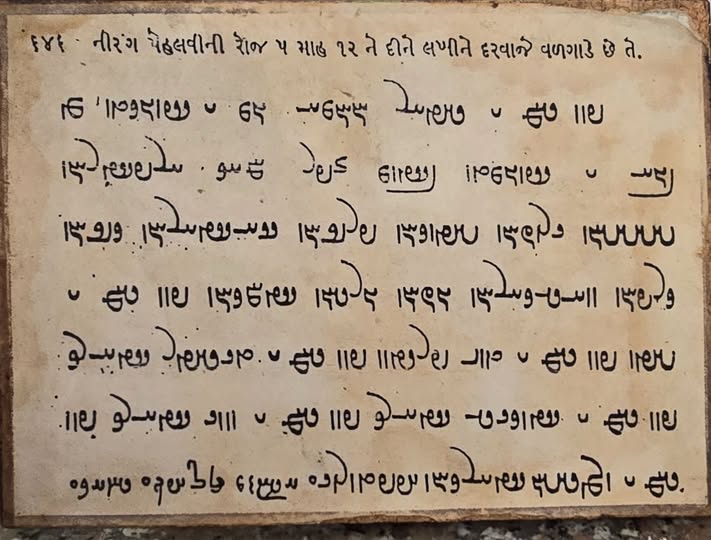
Courtesy : Rustam Jamasji
Can someone translate it to Gujarati or English please?
This image displays a Zoroastrian “Nirang” (a protective prayer or charm) written in the Pahlavi script (also known as Book Pahlavi or Middle Persian).
The Gujarati text at the top serves as an instruction:
૧૪૧ નીરંગ પેહલવીની રોજ ૫ માહ ૧૨ ને દીને લખીને દરવાજે વળગાડે છે તે. 141. Pahlavi Nirang, which is written and attached to the door on the 5th day (Spendarmad) of the 12th month (Spendarmad).
Identification and Significance
The script below the Gujarati is Pahlavi, an ancient Iranian script used for religious and administrative texts during the Sassanid Empire and by Zoroastrians for centuries thereafter.
This specific charm is known as the Nirang of Spendarmad or the Nirang of Faridun. In Zoroastrian tradition, the 5th day of the 12th month is dedicated to Spenta Armaiti (Spendarmad), the divinity presiding over the Earth. On this day, it is traditional to write this Pahlavi charm and paste it on the front door to protect the house from “khrafstars” (noxious creatures like snakes or scorpions), evil spirits, and misfortune.
Transliteration & Translation
While Pahlavi is highly ideographic and complex, this specific text is a standardized ritual formula. Here is the transliteration and translation of the core message shown:
Transliteration (Middle Persian):
Pa nām ī dādār Ohrmazd. Rōz ī Spendarmad Māh ī Spendarmad. Bast hom jādū, jādū-zad, dēv, druj, parīg, sāstār, kay, karap, gurg, mazu, khrafstar, zahar-hōmand, duš-čašm, duš-gōwišn. Bast hom az kōh ī Alborz, kōh ī Damāvand. Pa kām ī Shāh Farīdūn. Kerfeh mozd.
Translation:
“In the name of the Creator Hormazd. On the day of Spendarmad, in the month of Spendarmad.
I have bound [the power of] sorcerers, those born of sorcery, demons (devs), falsehoods (drujs), witches (parikas), tyrants, the deaf and the blind (spiritual enemies), wolves, monsters, and noxious creatures (khrafstars).
I have bound those with the evil eye and evil speech. I have bound them to Mount Alborz and Mount Damavand. By the will of Shah Faridun (the legendary king who defeated evil). May there be reward for righteous deeds.”
Summary of the Content
The Binding: The central theme is “Bast hom” (I have bound). It acts as a spiritual seal against physical and spiritual dangers.
Faridun: The charm invokes Shah Faridun, a hero in Persian mythology famous for chaining the dragon-king Zohak (the personification of evil) to Mount Damavand.
Protection: It is meant to act as a “spiritual shield” for the household for the coming year.
Get back to me if you want any transliterations and explanations of Nirangs. Pl. ensure the text is cean and readable. My contact: raymond.doctor@gmail.com.
raiomond doctor