
Bheja Fry: Because Everyone Has a Brain… More or Less — A Book by Dr. Mazda Turel
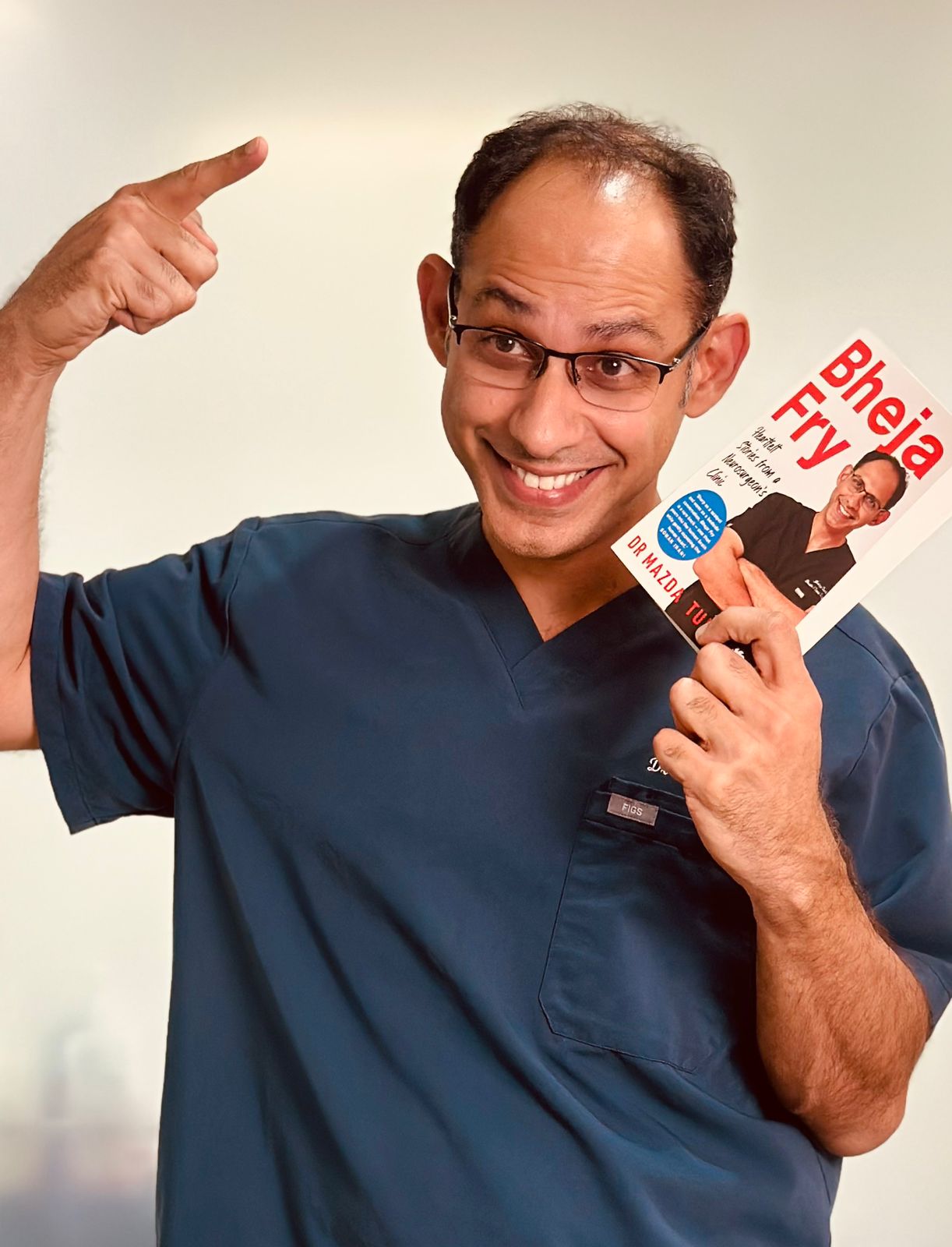
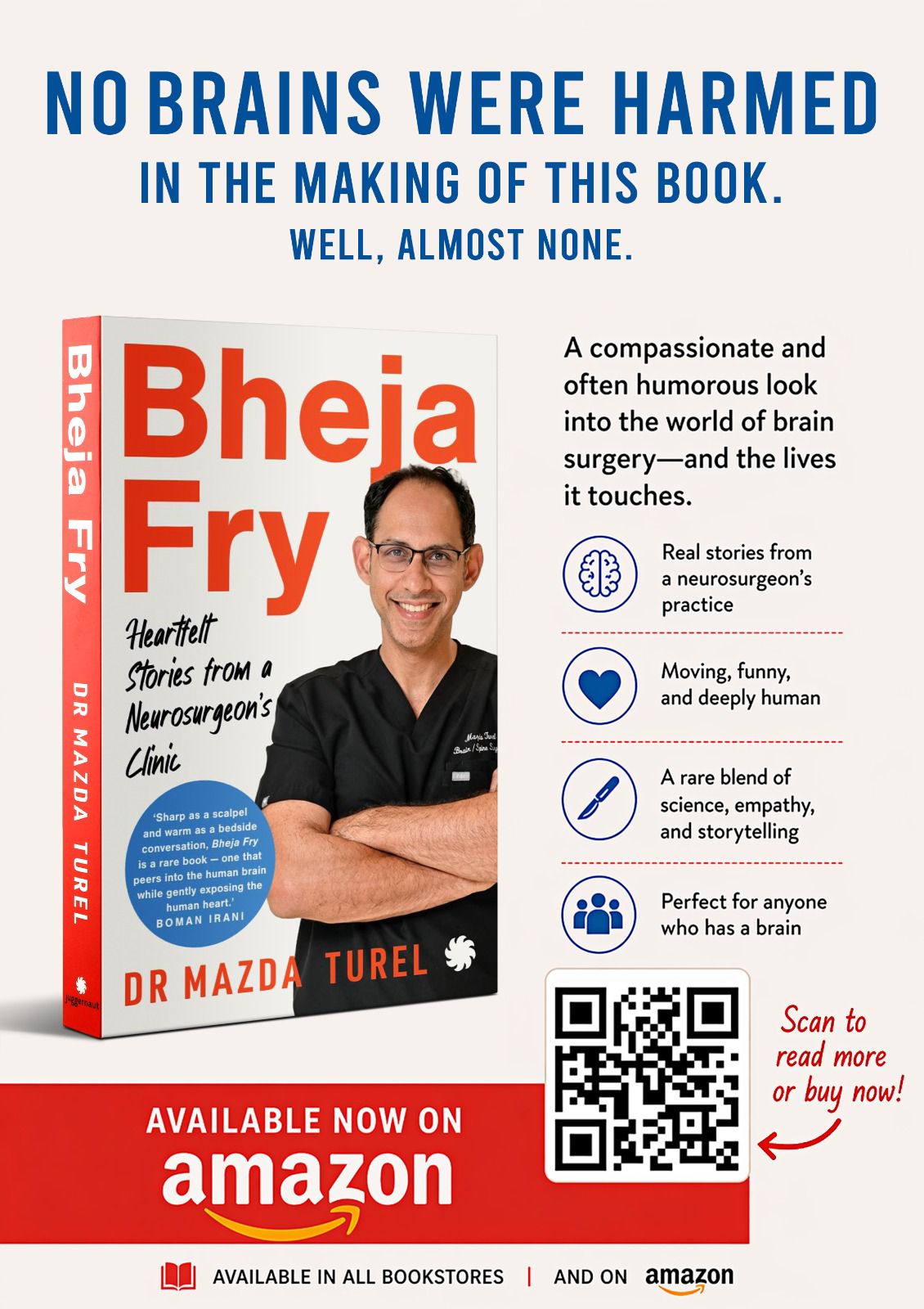
Compassionate Neurosurgeon Dr. Mazda Turel brings decades of life inside his clinic to his witty and moving book Bheja Fry: Heartfelt Stories from a Neurosurgeon’s Clinic (Juggernaut, 21 April 2026), where medicine meets the sheer unpredictability of being human. Bheja Fry isn’t just a book—it’s what happens when life fries your brain a little… and you decide to laugh anyway. Dr. Turel proves that even amid OPDs, rounds, and emergencies, there’s always room for a good story.
First things first—why the name Bheja Fry? Should we be worried about your bheja?
My bheja is completely raw. But that’s exactly the point. Life fries your brain. It heats you up, scrambles your thoughts, and leaves you wondering what just happened. One day you think you’re in control, and the next day, everything has unravelled. But if you cook the bheja long enough with care and with the right amount of spice, it can taste surprisingly good. Similarly, if you sit with the book you start seeing patterns, meaning, even clarity. That’s what the book tries to do.
Also, I love the dish. It’s comfort food, it’s unpretentious, it’s for the common man. That’s how I see this book—no jargon, no intellectual gymnastics, just honest storytelling. And don’t worry—even vegetarians can enjoy it! I also know that its sounds a bit callous to name a book Bheja Fry in the middle of a world oil crisis.
You’ve said writing the book was the easy part. That’s hard to believe.
It surprises people, but it’s true. Writing has always been a joyful process for me. The stories were already there—I just had to put them down. No brains were harmed in the making of this book… well, almost none! I thoroughly enjoyed the process of writing, re-drafting, writing new stories. It was fun!
The real challenge is everything that comes after. Convincing people to buy the book, to read it—that’s where things get tricky. Everyone wants a free copy. Even people who know people who know me want a free copy. I keep saying, “At least support the author’s bheja!” Writing may be effortless, but reaching readers—that’s the real struggle.
Let’s go back a bit. Where did your writing journey begin?
It began very informally. I used to send out New Year emails to friends, long, rambling, slightly mad messages from my Hotmail account – madzu@hotmail.com. I didn’t think much of them, but my friends found them hilarious. That’s when I realised that maybe I had something worth sharing.
I continued writing through medical school, often as a way to process what I was experiencing. It was mostly about my travels. But medicine exposes you to such a wide spectrum of human emotion—fear, hope, grief, resilience—that you need an outlet. Writing became that outlet for me.
And how did Jam-e-Jamshed enter the picture?
Jam-e-Jamshed was a turning point. After I completed my training in neurosurgery, I began contributing columns there. It’s such an iconic publication in the Parsi community, with a readership that is both loyal and discerning. Writing for Jam-e-Jamshed meant writing for people who would actually read every word, respond to it, and remember it.
What I loved most was the connection. Readers would come up to me at Parsi functions and say, “We read your column this week!” or “We were waiting for your next piece.” I will always be eternally grateful to Jame for allowing me a foot in the door.
You mentioned a loyal readership…
Oh yes! My biggest fans are 70-year-young single Parsi women who eagerly wait for my articles. They read everything I write, and they don’t hesitate to tell me what they think.
How did your writing evolve beyond Jam-e-Jamshed?
Over time, while continuing to write for the Jam-e-Jamshed I began writing for Mid-Day as well, which gave me a broader audience. People kept telling me, “Why don’t you compile these into a book?” At first, I wasn’t sure. Articles live in the moment, but a book feels more permanent. But the idea stayed with me. Eventually, I realised that there was value in bringing everything together, in giving readers a single space where they could access these stories, revisit them, and experience them as a whole.
So that’s how Bheja Fry was born?
Exactly. The book is a collection, but it’s also more than that. Many of the stories have been redrafted, reworked, and refined. There was follow mentions of what happened to these patient’s years later. New ones have been added. It’s not just a compilation—it’s a reimagining.
The first chapter, for instance—my journey from Vegas to Vellore—sets the tone.
What is Bheja Fry really about?
 It’s about life in all its contradictions. Love and loss. Grief and grace. Hope and despair. These aren’t abstract ideas—they’re things we experience every day. And also deals with Parsis’ unresolvable diagnosis- where logic takes a backseat and confusion gets a front-row view!
The book doesn’t try to resolve these contradictions. Instead, it sits with them. It says, “Yes, this is messy. Yes, this is confusing. But there’s also humour here, if you’re willing to see it.”
Your writing often blends humour with serious themes. Is that deliberate?
Very much so. Medicine is inherently dramatic, it deals with life and death, after all. But it’s also full of moments that are strangely funny, sometimes even absurd. Humour becomes a way to cope. Patients look to you not just for treatment, but for reassurance, for a sense that things will be okay, even when they’re not. And sometimes, a light moment can make all the difference.
This book doesn’t trivialise pain and suffering or what that matter even death. It acknowledges it. But it also shows that you can live with it, even laugh in the midst of it.
As a neurosurgeon, you’re often described as someone “entrusted with the wiring of human existence.” That’s a remarkable responsibility. How has that shaped the way you see stories—and storytelling?
I don’t take any label seriously. But it really is a privilege, and also a constant reminder of how fragile and extraordinary life is. Medicine, especially neuroscience, is full of real stories—and these stories that are often stranger than fiction. You see a man who wakes up after surgery remembering his childhood vividly, but unable to recall his daughter’s wedding. You see a woman paralysed from the neck down who laughs before she allows herself to cry. A single haemorrhage can turn a brilliant professor into someone who must relearn how to walk, speak, even think.
And then there’s everything that happens outside the ICU and the operating theatre—the families waiting, hoping, fearing. The spectrum of human emotion you witness is immense. Triumph and loss, humour and tragedy, absurdity and awe—they all exist side by side. That’s where these stories come from, and that’s why I write.
Why a book, when people could just read your work online?
Because a book is personal. It’s something you can hold, return to, and even pass on. Online content is fleeting—it gets lost in the scroll. Also I’m old schooled. Or old fashioned – call it what you may.
This was also on my bucket list. One day, I want to tell my grandchildren in the future, “Go read my book.” There’s something special about that.
Be honest—what do you want readers to take away from Bheja Fry?
I want them to feel something. To laugh, to think, to maybe reach out to someone they care about and hug them. And yes I want them to take away many copies and gift it!
What’s next? Another book?
If this is Bheja Fry, maybe the next one will be Deep Fried! Though given the global oil crisis, that might be a risky title, but hopefully the war will be over by then. If my book does well, maybe get ready for the next book.
One final thought—what does Bheja Fry leave us with?
Don’t take life too seriously. Feel everything, yes—but also learn to step back and laugh. Sometimes, that’s the only way through. Live light. Live free.
You can order the book on Amazon (https://tr.ee/CKfL06Y07O) or pick it up at your neighbourhood bookstore.
-Freny Daruwalla
Bheja fry buk i went on hunting at crossword kemps corner later ar fort kitab khana n left my name to call me but this buk should b charged half d price for sr citizen who have no way of earning but depend on pidly pension.pl consider half d buk price
How about Bheja Air Fry for a new title?