
Emotional Honesty – Zareer Masani
“Emotional honesty”
His confidence enabled Zareer Masani to express views that were unpopular with many
I have no precise recollection of the first time I met Zareer Masani. He maintained that we had initially got to know each other in my London university days, but my earliest clear memory is of a dinner at his first London flat near Brompton Road, shortly after my wife Maneck and I got married. He made an immediate impression on me, not only because of the sparkling intellect others had already spoken of but also because of his startling emotional honesty.
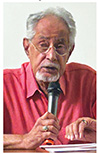
Zareer Masani: courage of his convictions
There he was talking quite openly, in the presence of somebody he barely knew, about his all too brief affair with an American he had met in London; soon after the American went back to New York, Zareer followed him, only to return very shortly when he realized that the American had lost interest in him. He recounted this experience of being jilted without a hint of self-pity — if anything, with self-deprecating humor, almost as though he were talking about another person. Some who knew him for many years may have interpreted his blow-by-blow account of thwarted love as an illustration of an egocentricity that marked much of his behavior throughout his life. I found this facet of his character both endearing and admirable: a readiness to admit vulnerability when many in similar circumstances would have tried hard to conceal it.
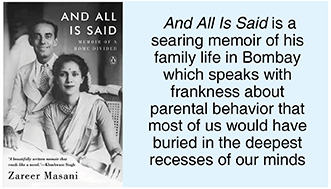
This emotional integrity strikes me as one aspect of the courage that he demonstrated throughout his life — the courage that allowed him to write his book And All Is Said, a searing memoir of his family life in Bombay which spoke with a frankness about parental behavior that most of us would have buried in the deepest recesses of our minds (see “The politician and the princess,” Books, Parsiana, July 21, 2012); the courage that drove him to declare his homosexuality at a time when it was regarded as quite unacceptable, particularly so in India; the courage of his convictions that enabled him in his later years to express unpopular right-wing views that he knew would meet with scathing disapproval from some of his peers and audiences; the courage that, finally, took him to Switzerland, where he ended his life.
 This courage cannot, however, be decoupled from behavior that could sometimes come across as harsh. He appeared to think nothing, for example, of talking about the sexual shenanigans of high profile figures in Bombay. Once, when Maneck and I demurred about these matters being made the subject of dinner table conversation, he responded with a scathing criticism of the double lives of those individuals. If he could be open about himself and his family background, why couldn’t others, he seemed to think. Although he didn’t make the point explicit, he appeared to feel that his own honesty gave him licence to reveal the secrets of others, never mind the potentially cruel consequences of doing so. I don’t believe that he meant to be cruel, but he did seem to be of the view that those who had things to hide had only themselves to blame if their behavior came to light. If we challenged him about the reliability of his information, he would simply assert that he knew for a fact that everything he said was true.
Assertive Zareer certainly was. One of my earlier memories of his assertiveness, which in practice often meant argumentativeness, goes back to happier times, when Maneck and I lived in a pretty square in the Angel area of Islington. Zareer and his friend Dave, who was his partner for many years, were regular guests at our place. Their arrival was often announced by voices from the other side of the square, becoming progressively louder until there was a knock at our door. We knew well before hearing the knock that Zareer and Dave had been having an argument. No sooner had they entered our house than Zareer would try to corral us into agreeing with his side of the argument.
One evening, we had a small dinner party that included the two of them, our Scottish neighbor Roderick and my cousin Caroline. The conversation soon segued into a lively political discussion which became increasingly heated, as Zareer, who at the time saw himself as a Marxist, crossed swords with the far more right-wing Roderick. Suddenly, to everyone’s astonishment, Roderick sprang to his feet, declared he had had enough, and strode out of the room! Maneck and I made a weak attempt to persuade him to stay, but he was out of the house in a jiffy. Then it was Zareer’s turn to get up. “I’m leaving too,” he announced. Caroline and the two of us looked on nonplussed. Why was he leaving, we asked. “Because you never supported me,” he cried out, turning to Maneck. But, we spluttered, how could we, as hosts, take sides? Mollified after a little persuasion, he agreed to stay on.
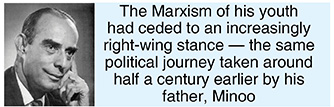
More often than not, Zareer’s argumentativeness was entertaining, good humored and witty. And his sharp brain and erudition often ensured that he won the argument. As the years passed, however, he became increasingly aggressive and intolerant of the views of others. The Marxism of his youth had ceded to an increasingly right-wing stance — the same political journey taken around half a century earlier by his father, Minoo Masani, who was to become leader of the Swatantra Party. Not so long ago, he called The Guardian newspaper a “rag,” knowing full well that The Guardian was my paper of choice. When I reminded him that I didn’t call the Daily Telegraph a rag, knowing that it was the paper he now favored, he laughed off his earlier remark.
He could be particularly patronizing towards Maneck. When he learned that we were planning to have a pet dog, he insisted dogmatically that Maneck would never be able to care for a dog. Years later he admitted that he had been proved completely wrong: it was Maneck more than anyone else who, for over 13 years, loved and cared for Popeye, our little black pug.
Maneck and I were fortunate that our relationship with Zareer continued uninterrupted for many decades. Even when our differences were stark and words exchanged could be sharp, they never resulted in a rupture. I believe his honesty — intellectual as well as emotional — had a major part to play: although we sparred about his increasingly right-wing views, it was difficult not to acknowledge his unwavering commitment to democracy, the courage of his convictions and his contempt for hypocrisy — as reflected in his jibes about people on the left of the political spectrum; those jibes, though, were frequently good humored, even affectionate, as if he were directing them at his youthful self.
 Unfortunately, his relations with a number of his other friends, some of whom had known him — as Maneck had — from their Elphinstone College days, came close to breakdown in the many months leading up to his passing. Thankfully, in most cases he and his friends came together towards the end of his life. Zareer never hesitated to tell us about his quarrels, always strongly justifying his own position. He was often unable — some might say unwilling — to see the other point of view. For all his intellectual brilliance, he seemed not to understand the hurt he sometimes caused others. Whatever the merits of the arguments on both sides, there was, sadly, one complaint that, like a leitmotif, ran through all the accounts given by friends with whom he had fallen out: differences of opinion could too easily descend into language that was personal, barbed and even insulting.
Why did Zareer antagonize these friends in his later years? The frustration arising from his increasing infirmity — heart and kidney problems, COPD (chronic obstructive pulmonary disease) — could have been a contributory factor. I feel he might have also harbored a more deep-seated anger (possibly stemming from a troubled childhood) that did not surface prominently as long as his health allowed him to be the successful historian, author and British Broadcasting Corporation (BBC) producer admired and feted by so many. In his later, frailer years he prided himself on being a lone voice fighting against the perceived (what he scathingly called “woke”) political opinion prevalent in liberal circles. But being outside the mainstream — and becoming more infirm at the same time — also made the anger in that voice more evident, sometimes bordering on irrational rage.
This was occasionally unleashed against total strangers, as Maneck and I once witnessed at Wigmore Hall. At the time of Covid, all concertgoers were expected to queue outside the Hall and only allowed to enter some minutes before the performance was due to begin. At one of these concerts, waiting in line, Maneck and I saw Zareer queuing from the other end. When we met halfway, he was fuming. We realized later that he had been furious with his heart specialist for having treated him in a cavalier way when giving him some bad news. When we reached the entrance door manned by an usherette checking tickets, Zareer started screaming at her about the long wait in the queue and, oblivious of the commotion he was causing, continued shouting uncontrollably at all the other ushers as we entered the foyer. We sat in our separate seats, and by the time the interval came he had regained his calm, behaving as though nothing untoward had happened.
It would be quite wrong to give the impression that Zareer fell out with all his friends. Thinking back, I feel that relations became particularly difficult with some of his Indian friends, perhaps because he knew them the longest and, in some instances, most intimately. By contrast, his dealings with some of his English friends appear to have remained relatively harmonious. Gwyneth Williams, former controller of BBC Radio 4, of whom Zareer always spoke with great affection, had this to say on learning of his death: “…he was so full of fight and emotion — despite his rationality — just so full of life, always engaged in the world of geopolitics, a true intellectual, generous, elegant, a loyal friend…”
This is a verbatim quote because it encapsulates so many of Zareer’s best qualities. Generous, most certainly — never stinting on entertaining us, often supportive (as I found when he gave his time to promote my debut novel The People We Know), and whole-hearted in bequeathing huge amounts of his wealth to animal charities; elegant, equally certainly — in his manners (he was the most punctual of guests!) and in the beauty of his home, so tastefully decorated with antique objets d’art and furniture; and loyal, without a doubt in our experience — notwithstanding our periodic contretemps, it was he who was often the first to pick up the phone and ask when we were free to meet.
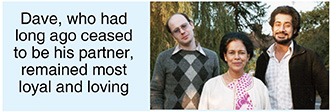
Above: Dave (l) and Zareer Masani with mother Shakuntala (center)
Zareer did not have another partner after his relationship with Dave ended, a break-up for which he expressed regret more than once. Sometimes at an opera performance at Covent Garden we would spot him from our area of the auditorium (always less expensive than his!) occupying an aisle seat in the stalls. There was Dr Zareer Masani — the blazing intellectual who could hold his own in any public forum, his erudition on display for all to admire — now a solitary figure with a stranger seated next to him. More often than not our discussions about the performance, whether at the Royal Opera House or at Wigmore Hall, took place after, rather than during, the event.
Learning last year about Zareer’s plan to end his life in Switzerland in the month of November, we were in a state of shock and went into denial. We clung to the hope that he would not carry out his plan, comforting ourselves with the knowledge that he had done nothing about the lethal drugs from China that he had kept in his fridge for so many years. We exchanged emails with him, in which we stated (as I believe other friends did too) that, although we respected his wishes, our thinking on the subject was very different: he still had so much to live for, his quality of life was hardly dire and he retained his joie de vivre (evidenced by his concert going, socializing with friends, and his writing and speaking engagements) — and medical advances offered hope for the future.
His riposte was that he had nobody to live for, unlike those of us with families (family members to whom he was close had died, and he felt unable to look after another dog after the death the previous year of his much-loved dog Suzie); that he hated the prospect of becoming dependent on others; and that his father and his favorite aunt, both fervent advocates of assisted dying, had never been able to carry out their wishes. His father died an enfeebled man, so different from the powerful figure he had once been. Zareer, anxious to avoid the same fate, insisted that it was wise to make the journey to Switzerland while he still had the capacity to do so independently.
In the event, he was persuaded to defer his plan because an operation on his aortic valve held out the possibility of an improvement in his condition (in particular, his breathlessness). After the operation, he claimed not to have experienced any improvement (although we and other friends felt that his breathlessness had subsided somewhat). He re-scheduled his departure to April 2024. As that date approached, he informed his friends that his exit had to be postponed once more, this time to August, because he had to deal personally with matters relating to his estate, his accountant reportedly having let him down. This gave us hope that he was not as determined to go ahead with his plans as he professed.
While all this was happening, Maneck and I continued meeting him regularly, sometimes at our place, more often at a restaurant. He was as convivial as ever, and the subject of his departure seldom came up (his choice more than ours). There was an air of unreality. Neither we nor anybody else aware of Zareer’s plan knew how to cope with an experience quite beyond the realm of anything life had prepared us for. Our nights were often disturbed, fraught with tension and anxiety over how this sorry saga was going to end. I don’t think Zareer ever really understood how upset his friends were. We clutched at straws, hoping against hope that his plans would be deferred yet again and would fizzle out.
He appeared to have mellowed and frequently mentioned what good friends we had been to him. Dave, who had long ago ceased to be his partner, remained most loyal and loving, travelling from his home in Birmingham virtually every week to be with Zareer. Speaking to Dave, I became increasingly convinced that this time Zareer was indeed going to make the final trip to Switzerland.
The date was fixed for Friday, August 9. On Sunday, August 4 we hosted a lunch for him at a local Chinese restaurant. We asked our daughter Dinu and family to attend as well, as their presence would make the meal a less painful affair. Zareer was more open than ever before about his plans for the following Friday, although I found it very difficult to engage with him on this subject. He wasn’t his usual ebullient self — more quiet and thoughtful, almost gentle, an adjective one would never have associated with Zareer in his heyday. He even tolerated with good humor our six-year-old grandson clambering over him and showering him with hugs and kisses — a singular achievement for a man who always professed a strong preference for animals over children.
During the lunch, he repeated more than once, “You have been such good friends.” In the past, he would say “You are such good friends.” I doubt he was aware of the change of tense, but I certainly was. Maneck’s instinct, born of desperation, was to refuse to accept what now seemed inevitable. More resigned, I felt heartbroken at the thought of losing a friend who had been a part of our lives for so long, but heartbroken also because of the conviction that this final journey was so unnecessary and so premature.
When he got up to say goodbye, we gave each other a hug, and he said one last time, “You have been such a good friend.” Lost for speech, all I could manage was a shake of the head. Through the blur in my eyes I watched him hobble out, his elegant walking stick in one hand, his unmistakable figure, now more bent than before, silhouetted against the sunlight outside. The waitress gently handed me the receipt for the bill. “Is he a cousin or a close friend?” she asked kindly. Why cousin, I thought to myself. Wouldn’t “brother” have been the more natural thing to say? “A close friend,” I managed to blurt out.
– Parsiana – Sep 21 – Oct 6, 2024