
Supreme Court reconsiders Parsi membership, may expand rights for children of Parsi women
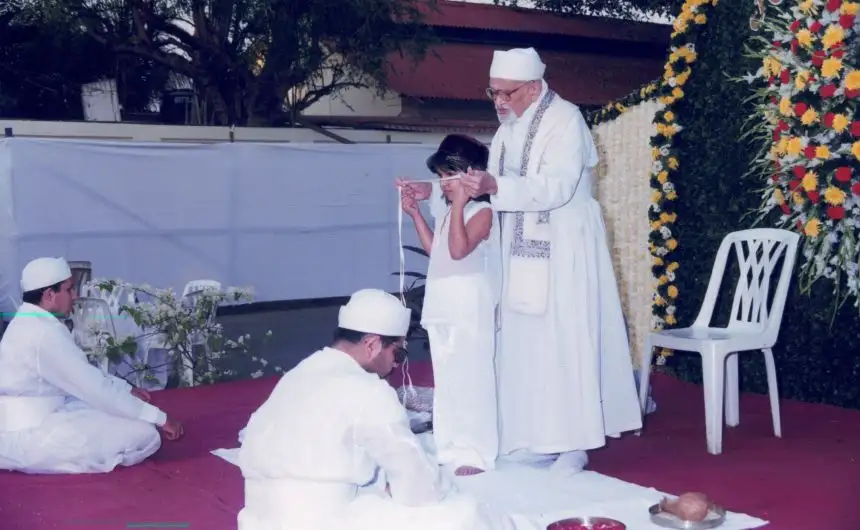
Author Rhea Mogul is initiated into the Zoroastrian faith by a Parsi priest in Mumbai in December 1999. Rhea Mogul/CNN
A landmark Supreme Court case challenges century old gender rules in the Parsi community, promising to unsettle traditions while offering a path toward inclusion.
As mentioned by CNN
Mumbai, India – the scent of burning sandalwood fills the room, to which only a very restricted circle of people are admitted. This is an agiary, a Zoroastrian place of worship for Parsis, where priests in white garments tend the sacred flame and recite ancient Avesta prayers that have endured for three millennia.
I stand before this flame, my head covered. Here I remember my Zoroastrian ancestors who once ruled a vast Persian Empire, but were driven from their homeland during the Muslim conquest about 1,300 years ago.
The Parsis are their descendants, a people who fled religious persecution and built their lives on India’s western coast.
This sacred hall is a place that most Indians will never see – even my daughter. That’s because she cannot become a Parsi, not from birth, but at all.
Strict gender rules mean that community members are considered only those born to a Parsi father. Parsi women who marry people of other faiths, like me, often find themselves on the margins, and their children are completely excluded.
History of Determining Belonging
The roots of this issue lie in the past: in 1908, a court in Bombay defined the Parsi community by strictly patriarchal criteria – only men could transmit religious belonging, regardless of whom they married. In the context of this case they mention the French citizen Suzanne Brière, who adopted Zoroastrianism after marrying a Tata representative, but she was attempted to be buried in the Tower of Silence in the Bombay region. Orthodox hardliners disputed, and the ruling affirmed their position. As a result, the daughter born to a Parsi mother with a non-Parsi father was not recognized as a Parsi under government standards. She remained bound by the ordinance and left it behind, and she herself was laid to rest and buried in Paris.
This precedent defined the formal exclusion of children of Parsi women who marry outside the faith from being eligible to join the religion, visit places of worship, and participate in Parsis’ programs available only to their own. Over time, many progressive clergy and community members rejected these rules, but the conflict continues.
Now the Supreme Court of India is hearing a landmark case that questions: who has the right to call themselves a Parsi?
The history of the Parsis in India demonstrates a community smaller in number than its influence. Among the famous are the Tata family (founders of Jaguar Land Rover), Marshal Sam Manekshaw, Homi J. Bhabha – the mind behind India’s nuclear program. Outside the country, Parsis gave the world Freddie Mercury, born Farrokh Bulsara, the charismatic frontman of the band Queen.
In 1941 the Parsis in India numbered over 100,000 people, but by 2011 their numbers had fallen to less than 60,000. Many left the country, others stayed and built new lives abroad.
I was born in Mumbai into a Parsi dynasty that has never been interrupted.
Born and raised in the very heart of South Mumbai, in a house built especially for our community, the history of our culture resonates in ceramic tiles and heavy dark wooden antique items.
My grandmother, Hilla Banaji, was deeply religious. She read prayers every day, wore the sacred Zoroastrian garb sudreh and kusti, and never left the house without praying before the large portrait of the Prophet Zarathustra above the entrance. She even encouraged me to find a “good Parsi boy” when I grow up.
I moved to Hong Kong, where I met someone outside the faith.
In contemporary Parsis society there is a broad reevaluation of the strict frameworks. The new generation of Parsi women is building independent lives under their own rules and more often views these norms not as sacred traditions but as something that needs change.
Sanaya Dalal – another Parsi who grew up near my line, in the Dadar Parsi Colony area, an elite enclave that starkly contrasts with the rest of Mumbai: quiet, slow pace of life, avoidance of the city bustle. She too left the faith and stayed in India, where her family is often excluded from religious and public gatherings.
To put it plainly, for her it’s a “colony-born child” – as she puts it: “We grew up here. Our friends are here. Our children are growing up here.”
We grew up here. Our friends are here. Our children are growing up here.
– Sanaya Dalal
Sanaya’s husband, Rishi Kishnani, grew up among Parsis; his mother was Parsi, but no one told him he was different – until he reached a cricket level and heard: No, no, you cannot play. He asked: Why not? Your father is not Parsi. He is now 48, but this exclusion leaves a deep mark – and he says it is happening to his son as well.
Jurisprudence about what it means to be Parsi is relatively new for this century-old sect. It has again become the subject of court cases, and further rulings could change how the community defines itself and who has access to its rituals and charitable programs.
Many people watch the case in the Supreme Court with concern, but changes must come from within the community, with the understanding that faith should not be a wall but a bridge.
At the Dadar Gymkhana, the venue where members who are not full members gather, my husband Rishi Kishnani confesses: his access was restricted; when they yelled that he was not Parsi, his child could not play there as often as other children.
Dalal explains that in response they decided to demand change, filed a suit with the Supreme Court of India, and expect a ruling in the coming months. “We are fighting for his right to worship, the right to a heritage, the right to social life and a dignified life,” says Sanaya Dalal. “I am no longer willing to tolerate the current state of affairs; discrimination does not stem from religion.”
We are fighting for his right to worship, the right to a heritage, the right to social life and a dignified life.
– Sanaya Dalal
The Dadar Parsi Gymkhana declined to comment, as the case is still in court. At the Dadar Athornan Institute, where new generations of Parsi clergy are trained, they say being Parsi is one of the oldest legacies worth fighting for. According to mentor Ramiyar Karanjia, the population is developing the belief that preserving faith must be compatible with the needs of the present, and that our duties lie in protecting religion and the community, but also in respecting individual fate.
Some data suggest that expanding rights for children of Parsi women may partially slow demographic decline, but most studies indicate that the impact depends heavily on the women themselves and the fertility rate within the community.
The history of the Parsis in India is a story of balancing preservation of tradition with adaptation to a new era. We need to wait for the Supreme Court’s decision and its repercussions for the future of the community.
The question before the Supreme Court is this: what will remain of the promise of inclusion if one’s own women and their children are left outside the community?
The discussion about the future of the Parsis in India continues, as the community seeks to reconcile preserving traditions with respect for diverse lives and individual choices. Waiting for the Supreme Court’s decision and its implications for the future of the Parsis means watching how one of the country’s oldest legacies evolves.
====================================
This is the story as shared by Rhea.
https://edition.cnn.com/2026/06/21/india/india-parsi-gender-court-case-intl-hnk-dst
A Principle of Mutual Respect Upholding Internal Tradition While Honoring Universal Faiths Before addressing the core legal mechanics it must be stated clearly that this defense is born out of an obligation to our heritage not out of malice toward any other community We hold the deepest respect for all external religious traditions beliefs and families Our position is strictly an administrative and internal theological necessity meant to preserve our own distinct micrminority culture without intending any disparagement toward the sacred choices or faiths of others
We stand before this esteemed Bench to address a matter that directly impacts the foundational architecture of the Parsi Zoroastrian communitys religious and charitable trusts This case does not merely concern the administration of properties it concerns the fundamental right of a minority religious denomination to manage its own internal affairs preserve its identity and honor the sacred mandates of its settlers under the protections guaranteed by the Constitution
Our arguments rest upon three immutable pillars
The Inviolability of Settlers Intent The public and private charitable trusts managed by institutions like the Bombay Parsi Punchayet BPP are governed by specific historic trust deeds Legally the original donors dedicated their private wealth for a strictly defined pool of beneficiaries anchored explicitly in patrilineal descent To alter or expand these definitions posthumously would constitute a direct violation of the settled law of trusts in India which mandates that the explicit intent of the creator of the trust must remain paramount and unalterable
The Practical Realities of Resource Management The community infrastructure most notably heavily subsidized housing in hyperdense urban zones like Mumbai is a strictly finite resource These assets were built to sustain a specific historic demographic Forcing the inclusion of children from intermarried families would create an unsustainable burden on these limited systems fundamentally diluting and depleting the vital resources meticulously preserved for families where both parents are Parsi
The Guarantee of Cultural and Denominational Autonomy For over a millennium the Parsi Zoroastrian community has survived as a distinct micrminority precisely by maintaining strict traditional boundaries of lineage and faith The reliance on patrilineal descent as the criteria for community benefits is an essential tenet of this survival Under Article 26 of the Constitution this religious denomination possesses the autonomy to manage its own affairs in matters of religion and institutional administration
To dismantle these criteria would be to rewrite history and jeopardize the very existence of a unique culture Therefore we respectfully pray that the sanctity of the original trust deeds be upheld and the administrative boundaries of the community be protected from external modification
Caution is in order here. Would Zarathustra approve of excluding people who are not Parsi from the choice of practicing the religion he started, the way his first followers did not have to have parents of a group to practice? Care must be taken to prevent defining Parsi as a race even though a tradition seems reasonable to define ancestors who escaped an Abrahamic religion of which Zarathustra would disapprove because all three Abrahamic religions claim God has to be propitiated through blood sacrifices. I do not think Zarathustra would approve of the sexism of the 1909 Supreme Court ruling.
I am a direct descendant of the 17th Century English settler Hannah Duston through my mother. To belong to the Hannah Duston Society, one need only be a direct descendant. When she was kidnapped to be sold into slavery by the Abenaki natives, who were made to do so by the Jesuit priests in pursuit of profits made by trapping bevers to make hats out of their skins, (Jesuits are part of another Abrahamic religion which would not be accepted by Zarathustra’s prohibition against not only the Abrahamic religions, but against killing innocent animals, especially for the frivolous purpose of making hats for rich people to follow fashion.) and when the natives smasher to death Hannah’s baby against a tree, she escaped by catching her guards asleep while spending the night on an island and killing them with one of their hatchets and stealing a canoe to sneak home during the nights and hiding during the days.
Present day residents vandalize her statue under the claim that what she did was racist. But the present-day Abenaki tribe revile what their ancestors did, denouncing their ancestors as the real racists. They are making a movie to tell the true story of Hannah Duston’s act of justified self-defense.
When there’s a clear understanding that a Zoroastrian girl goes to marry a non Zoroastrian man the offspring would not be accepted in the Zoroastrian faith, so why after knowing this fact choose this path and want to return back because of the offspring.
A crow is a bird that flies so does a bat which is a mammal but a crow cannot become a mammal nor can a bat a bird. The choice was made now live with it and enjoy it to the fullest, why try to pass down your erroneous decision to you child to return to the faith you have forgone
Mis-leading headlines frequently used about Davar Beamon case.
PATRILINEALITY was not given recognition or permission by these two judges.
How could they since the final decision has to be that of the Head Priests.
There’s was only an obiter dictum.
1. Why did India import Australin bulls instead of cows? (For increasing yeild of milk)
2. Mothers in law kill daughters in law or ask son to marry another girl if a son is not born… Because she is ignorant that it is the son who is responsible for the sex of the child.
3. Some believe that if a man has to go to heaven, his son must pour water in his mouth at the time of his death. Karma decides going to heaven or hell. Then, why this belief. Because racial characteristics are transmitted by males. I’m not MCP but these points need to be addressed in the Supreme Court.
Thank you for clearing it up. We leave the decision in their hands.
What happenes if trust deed specifies only children of both Zoroastrian parents
Even Zoroaster himself must have “converted” people when he first started and the first king was certainly a convert.
Also history tells us Zoroastrianism became the State religion. A state that at times spread from the Mediterranean to borders of India and China. How did it do that without conversion and inter marriage?
As far as I am aware there was no rule against conversion until Parsees arrived in India.
In Muslim Iran, conversion to Zoroastrianism was banned by the Muslim leaders.. But they didn’t mind people converting into the Muslim religion.
Which the Zoroastrians had to follow.
Also those promises were given when the parsees first arrived in India and then later were continued to probably make sure the locals would not join and taint the genes.
To do this, various rules and histories must have been made up and frankly invented to keep the Parsees separate and “pure”.
They were spread by the “learned” leaders and “experts” to keep their power and those stories over the centuries then gained respect and became “the law”.
But frankly nobody really knows what happened two thousand years ago
…
Excellent, the Supreme Court of India with Attorney Darius Khambatta an Indian Parsee Zoroastrian, will go through our 80 year ole Indian Democratic Secular Constitution that gives equal rights to all Indians to follow the faith they were born n raised in .Indian Parsee men have had this Right for over a Century and their children are embraced as Zoroastrians since then .
All the Supreme Court does now in 2026 is give such Rights to Indian Parsee Women ,so their children are Zoroastrian n thereby increase our population numbers that have declined since 5 decades.
This is a great decision as Zoroastrianism will go global once peace reigns in war torn Iran _the anscesteal land of our great Paigumber Zarathustra who will walk down Mount Demavans in Teheran,once more .
Kshnaothraoray Mazdao.
I believe in Ahura Mazda_The one true Divine Light and Being of a human being
Of all human lives on Gaia
My views:
1. Offspring having only one parsi parent can never be parsi. Similar to Anglo-Indian they could be probably Indo-Parsi.
2. How can such offspring add to parsi numbers ?
3. These offspring could certainly be Zoroastrian, as anyone can follow the prophet, and be entitled to worship at the firetemple.
Need to separate the community and the religion. Community is a bloodline. Religion is how you feel or think or believe.
Parsis can become Christian, or whatever.
But a Zoroastrian need not be parsi.
Best regards.
Rohinton
Rohinton Mehta