
Want to fix the Parsi birth rate? Protect the women
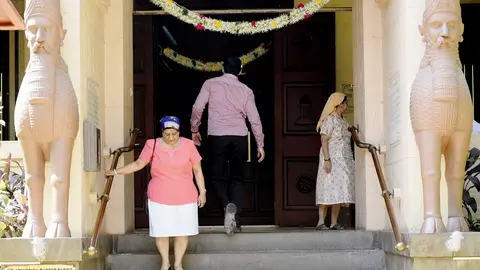
Parsi women are barred from worship at agiaries if they marry outside the community. File pic for representation
The Parsi Zoroastrian population is declining at 18 per cent each decade. Recent efforts to increase the Parsi population, including the National Commission for Minorities hosting a high-level national seminar last month, have missed a key reason for the consistent decline: an unjust law that leaves Parsi women destitute.
Between 2016 and 2019, the Indian Ministry of External Affairs received complaints from about 5000 Indian women who were abandoned overseas by husbands escaping their financial responsibility. Among these abandoned spouses, Parsi Zoroastrian women face additional cruelty, because Indian law provides a loophole to absconding Parsi husbands.
In India, the law that governs marriage and divorce is based on the person’s religion. The Shah Bano Case from 1985 shed light on the grievous harm to Muslim women through the misogynistic Muslim Divorce law. In court, Shah Bano won a moral victory, but it came without adequate or just compensation. Recent cases such as the Nagpur Parsi Panchayat case (filed by a woman who was denied entry to a Nagpur agiary for her grandmother’s funeral in 2024 because she had married outside the community) have focused on unequal marriage rules facing Parsi women who marry non Parsis. Intermarried Parsi women face vast discrimination in accessing their place of worship, inclusion of their children as Parsis, and access to other community benefits.

A newlywed Parsi couple pray in an agiary. Pic/ Special Arrangement
Parsis also follow an archaic and misogynistic law governing marriage and divorce. Due to an archaic British-era law – the Parsi Marriage and Divorce Act, 1936 – divorced Parsi spouses in India and overseas face gross injustice.
The 1936 law states, “Marriage contracted under the PMD Act cannot be dissolved by a decree of any other court except the Parsi Chief Matrimonial Court or the Parsi District Matrimonial Court with the aid of Parsi delegates.”
This harms divorced spouses abroad in many ways:
1 When a Parsi couple is married in India they become forever bound by this misogynistic law. So, even after obtaining a divorce in a US court, an absconding husband who runs away to India often escapes his legal obligations.
2 India has no treaty whereby a woman in the US can execute the divorce terms. Therefore, even when the wife was granted $200,000 in alimony and child support by the US court, she is unable to collect her rightful due.
3 The additional cruelty enforced by Parsi law is that it does not recognise the jurisdiction of any other court in any other country. It ignores rulings by foreign courts. The absconding husband can now again file for divorce, this time in India, in order to get a judgment where he can avoid alimony or child support. So the wife is now forced to bear the cost and trauma of re-litigating her divorce from overseas.
4 This process can take 5-10 years, without pendente lite (interim) relief. The Bombay High Court waits until the Parsi jury is convened (only three months a year). Parsi divorces are the only situation in India where a jury is called. A scathing article in Law School Policy Review by Ashirbad Nayak, titled Rights of Women: A Critical Study of the Jury System in Parsi Matrimonial Law, shows that in the slow and male-dominated jury system, jurors meet infrequently and make decisions influenced by community biases rather than strict law. This severely disadvantages women, who may endure public scrutiny and delays in cases of cruelty or incompatibility.
5 US Courts compute alimony and child support by considering both parties’ income and living expenses in the US. However, Indian courts consider only basic living expenses in India. The wife is forced to uproot herself and children who are US citizens to India where they have no connections. When the absconding husband has ample means and property, why doesn’t the court grant adequate maintenance instead of a pittance? This demonstrates ingrained patriarchy.
6 This law also harms Parsi men. For example, when an absconding wife has decamped to India with a minor child, even though the US court has granted the child’s custody to her US-based husband. Since India and USA have no treaty in these matters, such kidnappers break the law with impunity and a Parsi father loses his beloved child.
According to the National Judicial Academy, foreign divorce decrees pose a crippling and costly barrier, because Parsi law does not automatically recognise them. Section 32B provides limited grounds but no broad enforcement mechanism, leaving women to seek Indian court recognition under CPC Section 13 before collecting arrears or finalising status. In Y Narasimha Rao v Y Venkata Lakshmi (1991), the Indian Supreme Court set standards for foreign decrees, requiring alignment with Indian personal law, which can force re-litigation. Justice, it seems, is a luxury that impoverishes Parsi women.
Chavda Law Associates points out that foreign divorce decrees are not automatically enforceable in India, so a woman who wins alimony or child support abroad still needs to (again) bear the trauma and exorbitant cost to seek enforcement in India. This leaves abandoned wives with paper rights but no practical recovery or maintenance.
An article in Bar and Bench magazine points out that the resulting inequality is especially harsh where the husband returns to India and files fresh proceedings to reduce or erase support obligations. In such cases, the wife may be forced to re-litigate the divorce, pay more legal costs, and wait years for restitution while the husband continues to blithely evade responsibility. The combined effect is not only extreme financial hardship, but indicates that the legal system is slower to protect women than men.
Why isn’t the noble Parsi community outraged at such gross injustice? Why is a divorce granted in the US or UK not enforceable in India for Parsis? The Hindu Marriage Act, and even Muslim law often allow it, so that women of other religions may be able to enforce the rulings of foreign divorce courts. All Indian women should be spared this harsh burden.
Ignoring the Zoroastrians dictum of âgood thoughts, good words and, good deeds’, such Parsis and their enabling relatives demonstrate vile cruelty. Parsi men who shamefully abandon their financial responsibility should be scorned and ostracised.
Why doesn’t the Parsi community embrace the proposed Uniform Civil Code and demand justice for their daughters and sisters? While the Zoroastrian community touts gender equality, in India we find that it treats women shamefully. The staggering decline in birth rate indicates that Parsi women suspect how grievously Indian matrimonial law discriminates against them. Until the law offers full gender equality, perhaps the best advice to Parsi women is: “Don’t marry in India”.

Nawaz Merchant is President of the Zoroastrian Association of Greater New York. Writing as Nev March, she has published short stories, articles, and historical mysteries. She has received numerous literary awards and also teaches at Rutgers University’s Osher Institute
Perhaps the uniform civil code will halt this mismatch.
“Humanity and equality” are the pillars of Zoroastrianism.
But some very learned Zoroastrian scholars, by interpreting the religious decrees according to their own convenience, raise unnecessary controversies, court cases, and seem busy in separating and creating groups even though the Parsis are in a micro minority in India.
Even small Parsi children can now understand the evil policy of “divide and rule” of the British.
Taking the basis of trust deeds or court decisions of the British era, irregularities are committed in majority of the Parsi trust funds in India. The administration of trust funds is not done as per the 2022 judgment of the esteemed Supreme Court of India directives say “Public control is the first necessity for Honest administration of any of the Public Trust Funds registered in India” and by taking the basis of the Bombay High Court’s 1908 judgment, Parsi women are being treated discriminatoryly and forcing them to go to Courts of Law to get their rights under the Constitution of India.
The 1908 judgment of the Bombay High Court – directions were also given on how the authorized trustees should be selected or elected. But this directives from the Top Court in India have been totally ignored in Trustees appointment.
Are the trustees appointed in charitable or religious Parsi trust funds in India as per the rules? Absolutely No. Then why these trustees are having fond of issuing any orders to the community members, when they have not been appointed or elected as trustees by legal procedures?
Such opportunistic Parsi scholars are requested to refer their studies about the ideals of goodness of Zoroastrianism with sincerity.
Kind appeal to The Parsis of India:-
Zoroastrianism has given equal rights to men and women for thousands of years. Our small Avesta prayer “Yenghe Hatem” is its proof.
Emperor Cyrus published the first human rights charter in the world.
It is the duty of every person to cultivate all the natural resources of the universe and maintain a clean environment, which is explained in Zoroastrianism through the names of Ameshaspands and Yazads.
Fire, water, earth, sky, air, all these natural resources are sacred to the Parsis and to all the people of the brotherhood communities too.
If a dead body of any Parsi, who has been cremated as per his/her will at the designated place of cremation, it is strongly objected by the trustees and priests in an undemocratic way by arguing that the fire is polluted in final rituals through cremation and four days of after rituals denied. Who has given them these powers to issue such FATWA in world’s largest democratic nation India? They should publish a copy of order (if they have received such authoritative powers from Government of India) to the community.
This mindset immediately turns and rotates 90 degree, when in families of these orthodox Parsis, they are preparing non-vegetarian foods, by cooking meat, fish, chicken on the gas or electric stove at their houses. In a process of cooking meat on a fire at home, it is not being polluted!
The trustees of the philanthropic institutions, hospitals, clinics established by Parsi ancestors are turning these institutions of human services into ruins by their rigid mentality, not to change the trust deed from Only Parsis to avail these healthcare services for all the brotherhood communities by which Parsis would also get latest healthcare services in replacement of Bawa Adam healthcare equipments in these Parsi Hospitals.
These Parsi trustees of such having rigid mentality are hearby requested to adopt the similar mentality in their personal businesses and trades too by boycotting customers from brotherhood communities in their Shop. Parsis of India desires to see a banners that have writings on it “Only for Parsis” on the business shop of Parsi trustees too.
Now you can easily understand the true realities of these so called orthodox Parsis in India and their smartness in interpretating Zoroastrianism and its ideals in a manner that is convenient to them first! Any brotherhood community in India would not tolerate such people of Ostriches behaviour.
The Parsis of India have always been united against negative elements and will always remain united, keeping the Parsi prestige high by truly following ideals of our good religion – Zoroastrianism.
Atha Jamayat –
Yatha Afrinami.
🙏 🌷 🙏